 Written by
  Edited by
  Edited by

Known for its size, success and seeming ubiquity, Walmart (ticker symbol: WMT) is a discount retailer that has had a tremendous run on Wall Street. Founded by Sam Walton in 1962, the corporation went public in 1970, debuting at $16.50 per share. Since then, the retail leader has had 11 two-for-one (2:1) stock splits and one three-for-one (3:1) split, with its closing price hitting an all-time high in May 2026 at more than $135. It’s been pointed out that if you’d bought 100 shares of the initial public offering for $1,650, you would have 614,400 shares today. Meanwhile, the company has increased its cash dividend every year since it first paid $.05 in 1974. In the age of Amazon and online shopping, many stock pickers have shunned Walmart, thinking that its days of wild growth are behind it but if you’d like to buy in, there are several ways to purchase shares.
Ask a financial advisor about the right investments for your portfolio based on your financial goals, risk tolerance and time horizon.
How to Buy Walmart Stock: Direct Investment
For those who want to skip the middleman, direct investment is an option with Walmart shares. The company makes its stock available to investors, including Walmart employees, through the Computershare system. Here are a few key points to know:
- You don’t need a lot of money to get started; the minimum investment for new shareholders is $250 or $25 if you set up a recurring investment.
- There’s an initial setup fee of $20, and a per transaction fee that applies to both one-time and recurring investments.
- You’re limited to a maximum yearly investment if you buy shares through Computershare.
- Computershare completes your buy and sell orders as it receives them, so you have no control over the price you pay (or receive, if selling).
Compared with investing apps and online brokerages that offer no-commission trades, you’ll pay more in fees. That may or may not be a dealbreaker, depending on how you normally prefer to purchase stock.
You’lll need to create a Computershare login to buy shares. If you need assistance or prefer to buy stock over the phone, you can also call 800-438-6278. To stay up to date with the latest shareholder information, you can download the Walmart Investor Relations app on Apple, Android and Windows phones.
When it comes to your dividends, you have two options: either reinvest them or have them deposited in your bank account. There are no fees for automatic reinvesting. Here’s a full breakdown of the fees, minimums and other requirements to buy Walmart stock directly through Computershare.
Direct Investment Fees and Minimums
| Category | Costs |
|---|---|
| Minimum Investments | Initial investment: $250 or 10 monthly automatic deposits of $25 All other investments: $50 check deposit or $25 online bank debit Maximum investment: $150,000 annually |
| Purchase Fees | One-time enrollment fee: $20Each one-time online bank debit: $1 + $0.05/share Each check deposit: $5 + $0.05/share Automatic bank account withdrawal: $1 + $0.05/share Returned check/rejected ACH debit: $20 |
| Dividend Reinvestment | All costs covered by Walmart |
| Stock Sale Fees | Each batch and market order sale: $25.50 + $0.05/share Fees are paid via the proceeds of your sale |
How to Buy Walmart Stock: Brokerage Account
For many self-directed investors, using a brokerage, especially an online one, probably makes the most sense. While you could theoretically invest in a number of companies through each company’s direct investment plan, a brokerage allows you to do this with just one account. If it’s online, you likely will pay no or low fees. On top of this, you have more control over prices.
Stock trades at brokerages come in two forms: limit orders and market orders. If you’re content with the current price of a stock, you’d enact a market order for the number of shares you want to buy or sell. On the other hand, limit orders let you preset a specific price a stock must hit before your account triggers a purchase or sale. That flexibility is an advantage you won’t get when buying Walmart shares directly through Computershare.
Brokerage Comparison
| Brokerage Firm | Trading Fees | Minimum | Best For |
|---|---|---|---|
| Robinhood Read Review | $0 | $0 | Mobile/online traders Self-sufficient investors |
| Merrill Edge Read Review | $0 | $0 | Bank of America account holders Customer support users |
| Charles Schwab Read review | $0 | $0 | 24/7 customer support Full-service advisor support |
Some brokerages offer fractional share trading, which allows you to buy partial shares of stocks for as little as $1. You may consider a brokerage that has that option to purchase Walmart stock if you’re starting to invest with a smaller amount of money, or would like to spread your investments out across multiple higher-value stocks.
How to Buy Walmart Stock: Financial Advisors
Working with a financial advisor offers the benefit of professional advice when deciding which stocks to buy or sell. You can tell your advice what you’d like your portfolio to include, and they can help you evaluate those choices against the backdrop of your larger financial plan.
Buying Walmart stock (or any other stock) through an advisor comes with the benefit of their knowledge and expertise. The caveat of working with an advisory firm is that they may have higher fees than both brokerages and direct investment plans.
However, financial advisors will almost always build clients a holistic financial plan in conjunction with their portfolio. This ultimately drives the cost of their services up, making them potentially unattainable for lower-level investors.
Overview of Walmart
Of Walmart’s nearly 11,000 stores, roughly half are within U.S. borders. There are about 2.1 employees worldwide, including 1.6 million Americans. In addition to its many Walmart locations, the company owns and runs Sam’s Club, a large wholesale chain. Without factoring in Walmart’s earnings, Sam’s Club saw an impressive $84.3 billion in revenue over the 2023 fiscal year. Beyond this, Walmart is now involved in the e-commerce business:
Walmart Overview
| U.S./International Retail Stores and Distribution Centers | Walmart Supercenters Walmart Discount Stores Walmart Neighborhood Market Over 150 U.S. distribution centers Small formats |
| Sam’s Club | Membership-based wholesale club 600 locations in the U.S. and Puerto Rico |
| Walmart U.S. eCommerce | Proprietary e-commerce fulfillment centers |
Walmart’s Financial Profile
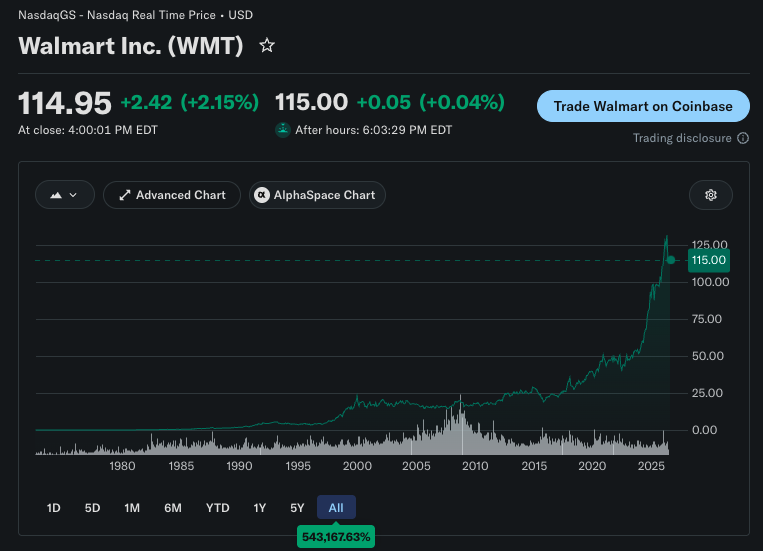
(Past performance does not guarantee future results. Chart from July 2026.)
Walmart has consistently reported strong financials for a half century. And after each stock split, when the share price was halved, the price climbed back up, in effect, doubling investors’ money or more. That said, e-commerce has taken a bite out of Walmart’s earnings, and when the company was struggling to come up with an answer, its stock fell in 2015 from $90.02 in January to $57.87 in November.
Still, the stock is a dividend aristocrat and retains its blue-chip status. What’s more, some analysts think that Walmart, with its gigantic footprint, may be able to beat Amazon at its own game of free, same-day delivery. In 2019, it announced it would lower shipping costs by using its many stores as distribution centers.
It can be hard to visualize what the long-term returns of a stock can be. But as an example, if you’d invested $1,000 in Walmart stock in 2005, it would’ve been worth roughly $10,277 today, which is a 1,000% return.
Walmart Dividend History and Reinvestment Strategy
Walmart has paid dividends every year since 1974 and has increased its payout annually for decades. This track record makes it a dividend aristocrat, a term for companies that have raised dividends for at least 25 consecutive years. For income-focused investors, this consistency shows that Walmart has been able to share profits with shareholders even during challenging economic times. Here a few highlights of Walmart’s dividend plan:
- The company currently pays dividends quarterly, meaning investors receive four payments each year.
- The amount you receive depends on how many shares you own and the dividend per share set by the company’s board.
- While Walmart’s dividend yield is modest compared to some high-yield stocks, its steady growth helps protect purchasing power over time.
Investors can choose to reinvest their dividends to buy more Walmart shares instead of taking the cash. Through Computershare or a brokerage account, reinvestment happens automatically, with no additional trading fees in most cases. This process allows dividends to compound, meaning each new share you purchase can also earn dividends in the future.
Over the long term, reinvesting dividends can significantly boost total returns. For example, an investor who bought Walmart shares and reinvested dividends over decades would have benefited not only from price appreciation but also from the growing number of shares owned. This strategy can be especially effective for long-term, risk-averse investors who value stability and steady income growth.
Should You Buy Walmart Stock?
Whether Walmart stock is a good investment depends on your financial goals, risk tolerance and overall portfolio strategy. As one of the world’s largest retailers, Walmart has built a reputation for generating consistent revenue, maintaining a broad customer base and paying regular dividends. These characteristics may appeal to long-term investors seeking a relatively stable, blue-chip stock.
At the same time, no individual stock is without risk. Walmart’s financial performance can be affected by factors such as changing consumer spending, inflation, supply chain costs, labor expenses and increased competition from retailers and e-commerce companies. While the company’s size and market position may help it navigate economic challenges, its stock price can still fluctuate with broader market conditions.
Before buying Walmart stock, consider how it fits within your existing portfolio. Investing too heavily in a single company can increase concentration risk, even if that company has a long track record of success. Many investors use individual stocks like Walmart to complement a diversified portfolio that includes funds, bonds and other asset classes.
If you’re unsure whether Walmart aligns with your investment objectives, reviewing your asset allocation and long-term financial plan can help. A financial advisor can also help you determine whether adding an individual stock supports your broader investing strategy or whether a more diversified approach may better match your goals.
Bottom Line

Walmart has long been viewed as a stable, established company with a history of steady growth, making its stock an attractive option for many long-term investors. However, like any individual stock, it carries risks and should be evaluated in the context of your financial goals, risk tolerance and overall portfolio. Before investing, consider how Walmart fits into your broader investment strategy and whether maintaining a diversified portfolio is the best way to pursue your long-term objectives.
Tips for Investment Planning
- If you never know when to sell a stock, you’re not alone. Many people find it easier to buy than to sell. One solution is to have a sale price in mind when you buy the stock. Another is to hire a financial advisor. Finding a financial advisor doesn’t have to be hard. SmartAsset’s free tool matches you with vetted financial advisors who serve your area, and you can have a free introductory call with your advisor matches to decide which one you feel is right for you. If you’re ready to find an advisor who can help you achieve your financial goals, get started now.
- With a soaring bull market, many professionals don’t even try to beat it. Instead, they seek only to track it, which research shows will deliver better returns in the end. This is called passive investing, and instead of researching and following individual stocks, you simply choose your index and the mutual fund or exchange-traded fund (ETF) that uses the index as a benchmark.
Photo credit: ©iStock.com/Wolterk, Yahoo Finance, ©iStock.com/AndreyPopov