 Edited by
  Edited by
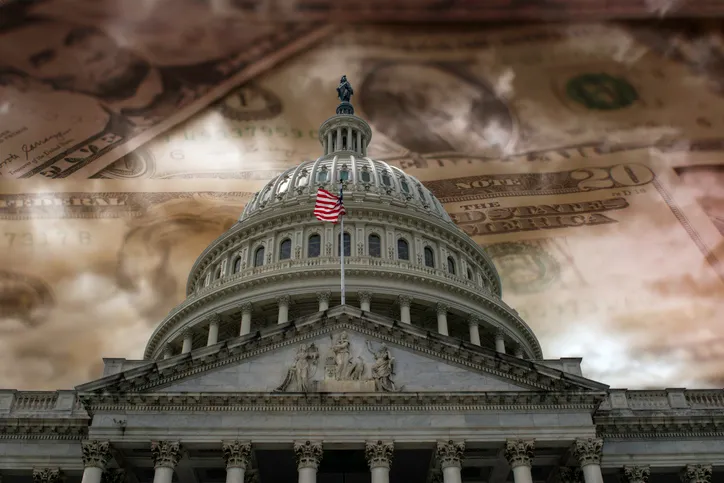
If the U.S. defaults on its debt, the government would fail to meet its financial obligations to bondholders. This would trigger widespread economic disruption. While the U.S. has never fully defaulted on its modern debt, it has come close during debt ceiling standoffs. A default would cause Treasury securities to lose their safe-haven status, sending interest rates soaring. Stock markets would likely plummet and retirement accounts would suffer. Borrowing costs for mortgages and loans would rise sharply for consumers, too.
A financial advisor can help assess your portfolio’s exposure to government securities and adjust your investment strategy accordingly.
What Is the Debt Ceiling and How Does Default Happen?
The debt ceiling is a legal limit set by Congress on how much money the federal government can borrow. When government spending exceeds tax revenue, the Treasury Department issues bonds to cover the shortfall.
The government borrows from a wide range of investors, including foreign governments like China and Japan. It also uses domestic institutional investors such as pension funds and insurance companies. Even individual Americans loan the U.S. money through savings bonds and retirement accounts. Once borrowing hits the ceiling, the Treasury cannot issue new debt without congressional approval to raise or suspend the limit.
Default becomes a risk when Congress fails to act before the government exhausts its cash reserves and accounting maneuvers. The Treasury Department can employ extraordinary measures to continue payments temporarily, such as suspending investments in certain government retirement funds. However, these tactics only buy time, typically a few months at most.
If the debt ceiling remains unchanged and cash runs out, the government must choose which bills to pay with incoming tax revenue alone. This forces impossible decisions between paying bondholders, Social Security recipients, military salaries, or government contractors. Missing any payment to bondholders constitutes a technical default, even if it’s brief. The consequences begin immediately as financial markets react to the unprecedented breach of America’s credit worthiness.
Immediate Consequences: What Happens to Financial Markets
Financial markets would likely react sharply to a US debt default, with Treasury bonds potentially experiencing their first-ever widespread sell-off. Investors holding trillions of dollars in government securities could rush to dump these assets. This would cause bond prices to fall and yields to rise substantially. Panic could spread across asset classes because Treasury bonds serve as the foundation for pricing nearly every other investment.
Stock markets would likely experience severe declines, potentially erasing trillions in market value within days. Money market funds, which many Americans use as cash alternatives, hold substantial Treasury securities and could “break the buck” by falling below their $1 share price.
Credit markets could freeze as lenders become unwilling to extend loans amid the chaos. The entire financial system relies on Treasury securities as collateral for overnight lending between banks. Without this trusted collateral, banks might hoard cash rather than lend it. Global markets would likely suffer alongside American ones, as Treasury bonds are held by central banks and investors worldwide who depend on their stability.
Impact on the Economy: Jobs, GDP and Recession
A debt default could trigger a severe recession that touches every corner of the American economy. Consumer confidence would likely collapse as households watch their investment portfolios shrink and news coverage amplifies fears about economic stability. This psychological shock could cause people to slash spending on everything from cars to restaurant meals, creating a rapid contraction in economic activity.
Businesses would likely respond to falling demand and tighter credit conditions by cutting jobs and canceling expansion plans. Unemployment could surge by several percentage points within months as companies struggle to access the loans they need for payroll and operations. Small businesses would be particularly vulnerable, as they typically have less cash reserves and depend more heavily on credit lines.
GDP growth would reverse sharply. Historically, nations see anywhere from 1.6-3.3% annual declines in the five years following default 1 . The 2023 debt ceiling standoff alone, which never reached actual default, was estimated to have cost the economy hundreds of thousands of jobs. 2 Higher interest rates resulting from default would make business investments less attractive, further dampening economic growth for years afterward.
How a Default Could Affect Your Personal Finances
Your personal finances would face pressure from multiple directions simultaneously. Retirement accounts invested in stocks and bonds would likely decline in value, potentially setting back your plans by years depending on your age and portfolio composition. Even conservative investors holding Treasury bonds directly would see paper losses, though holding to maturity would eventually return principal.
Interest rates on new borrowing would jump across the board. Mortgage rates could increase by one or two percentage points, adding hundreds of dollars to monthly payments on a typical home loan. Credit card rates and auto loans would similarly climb, making major purchases more expensive. Homeowners with adjustable-rate mortgages would see their payments rise at the next reset date.
Government benefit payments could face delays or reductions if the Treasury prioritizes bondholders over other obligations. Social Security checks, veterans benefits, and tax refunds might arrive late or be reduced temporarily. Federal employees could face furloughs without pay, similar to government shutdowns but potentially more severe. Your job security would depend heavily on your industry, with sectors tied to government spending or discretionary consumer purchases facing the greatest risk of layoffs.
Protecting Your Finances from Government Default
While you cannot control whether Congress raises the debt ceiling, you can take proactive steps to shield your finances from potential fallout. These strategies may help reduce your vulnerability to market volatility, rising interest rates, and economic uncertainty that would follow a default.
Diversify Your Investment Portfolio
Diversification becomes particularly valuable when facing systemic financial shocks like a potential default. Review your investment portfolio to understand your exposure to different asset classes, including the percentage held in stocks, bonds, cash and alternative investments.
Build an Emergency Fund
Building an emergency fund should be a priority if you haven’t already. Aim to set aside three to six months of living expenses in an accessible savings account or money market fund not heavily invested in Treasury securities. This cash cushion provides breathing room if you face a job loss or reduced income during the economic turbulence following a default.
Lock in Interest Rates Before They Rise
Consider locking in interest rates on major purchases before rates rise further. If you’re planning to buy a home or refinance your mortgage in the near future, accelerating that timeline could save thousands of dollars in interest payments. Similarly, paying down variable-rate debt like credit cards reduces your vulnerability to rate increases.
Stay Invested for the Long Term
Stay invested for the long term rather than selling everything during market panic. Historical evidence shows that markets recover from even severe shocks, and selling at the bottom locks in losses permanently. Despite all the tumult of the last two decades, $100 invested in 2000 would be worth $300 today. Younger investors with decades until retirement can view market downturns as opportunities to buy quality assets at reduced prices. 3
Bottom Line
A US debt default would represent an unprecedented financial crisis with far-reaching consequences for markets, the broader economy, and household budgets. Knowing what could potentially happen could help you make better decisions about your money before a crisis hits. Whether default occurs or not, maintaining a diversified investment strategy, building emergency savings and building a strong financial foundation can help you weather periods of economic uncertainty and political turbulence.
Investment Planning Tips
- A financial advisor can help you evaluate how a potential debt default could affect your holdings and identify ways to reduce your exposure. Finding a financial advisor doesn’t have to be hard. SmartAsset’s free tool matches you with vetted financial advisors who serve your area, and you can have a free introductory call with your advisor matches to decide which one you feel is right for you. If you’re ready to find an advisor who can help you achieve your financial goals, get started now.
- Building a diversified portfolio across multiple asset classes can be an effective way to manage risk during periods of economic uncertainty. These 13 investments could offer a range of options to consider.
Photo credit: ©iStock.com/Greggory DiSalvo, ©iStock.com/Urbanscape, ©iStock.com/Darren415
Article Sources
All articles are reviewed and updated by SmartAsset’s fact-checkers for accuracy. Visit our Editorial Policy for more details on our overall journalistic standards.
- Kenny, Sean. “The Aftermath of Sovereign Debt Crises.” CEPR, July 20, 2021, https://cepr.org/voxeu/columns/aftermath-sovereign-debt-crises.
- States: 2021—2025, 46th President. “White House Press Release – CEA: The Potential Economic Impacts of Various Debt Ceiling Scenarios | The American Presidency Project.” The American Presidency Project About Search The American Presidency Project About Search, May 3, 2023, https://www.presidency.ucsb.edu/documents/white-house-press-release-cea-the-potential-economic-impacts-various-debt-ceiling.
- What We’ve Learned From 150 Years of Stock Market Crashes. https://www.morningstar.com/economy/what-weve-learned-150-years-stock-market-crashes. Accessed Mar. 20, 2026.