 Written by
  Edited by
  Edited by
  Reviewed by

If you have a limited liability company (LLC), electing to have it taxed as an S corporation could be helpful. While an LLC typically pays taxes as a sole proprietorship or partnership by default, electing S corp status allows business owners to split income between salary and distributions. This can potentially reduce their self-employment tax liability. Of course, the process for choosing a tax status is entirely dependent on your business’s financial situation. Here’s what to consider if you want your LLC taxed as an S corp.
A financial advisor who specializes in corporate or small business taxes can help you develop your own tax strategy.
What Are the Benefits of Being an LLC?
A limited liability company is a popular choice for a business entity because of its simplicity and liability protection. The LLC business entity has several tax benefits over its alternatives, as well as other advantages:
- Limiting liability: LLC owners have limited personal liability for debts owed by the business. Typically, liability is no more than the amount they invest in the business. Partnership owners and sole proprietors may be personally liable for all business debts.
- Avoiding double taxation: An LLC is a pass-through entity. Its income passes straight to the owners as self-employment income, avoiding corporate income tax.
- Minimizing paperwork and overhead: Compared to a regular corporation, an LLC has fewer record-keeping and meeting requirements. This makes it simple for smaller businesses to operate.
In addition to these benefits, there are a lot of choices that LLC owners have when setting up the entity, especially from a tax standpoint.
What Are the Benefits of Being an LLC?
A limited liability company is a popular business structure because of its flexibility and liability protection. An LLC itself does not determine how a business is taxed. Depending on the number of owners and elections made, it may be taxed as a sole proprietorship, partnership, S corporation or C corporation.
- Limiting liability: LLC owners generally have limited personal liability for debts owed by the business. Typically, liability is no more than the amount they invest in the business. Partnership owners and sole proprietors may be personally liable for business debts.
- Flexible tax treatment: LLCs have flexibility in how they are taxed. By default, a single-member LLC is generally disregarded for federal income tax purposes, while a multi-member LLC is generally taxed as a partnership. An LLC can also elect to be taxed as a corporation.
- Minimizing paperwork and overhead: Compared with a corporation, an LLC generally has fewer record-keeping and meeting requirements, which can make it simpler for smaller businesses to operate.
In addition to liability protection and simpler administration, LLC owners can choose a tax classification that fits their business circumstances.
How Is LLC Income Taxed?
Most LLC income passes through to the owner’s or owners’ tax returns, depending on how the business is set up. However, there are multiple tax classifications an LLC can elect that may be more beneficial in certain situations. When an LLC opts for an S corporation taxation, for example, it changes how the IRS treats the business and its income for federal tax purposes.
When income from traditional LLCs passes through to owners, they pay tax on it as self-employment income. The self-employment tax comes to 15.3%, with Social Security and Medicare taxes comprising 12.4% and 2.9%, respectively. That isn’t the case with an S corporation tax structure. In this case the owners must receive a paycheck as an employee of the corporation, where the company pays half of the employment taxes.
As anyone who’s checked their pay stub knows, the tax rates for self-employment are higher than Social Security and Medicare taxes paid by average workers, because they cover both the employee and employer sides. As a result, in 2026 employers withhold just 6.2% for Social Security and 1.45% for Medicare from employees’ pay. The employers pay the other 6.2% for Social Security and 1.45% for Medicare without passing it on to employees. 1 The self-employed pay both halves, but have access to tax deductions.
There are two key factors to consider here:
- The IRS treats non-salary payouts from a corporation as a dividend rather than employment income. That means dividend recipients don’t have to pay Social Security and Medicare taxes on that income.
- The owner of an S corporation can let some of their business profits pass through as dividends. That portion of their income would be free of self-employment tax.
Treating an LLC treated as an S corp for tax purposes may save a small business owner a considerable amount in employment tax payments.
How an LLC Is Taxed as an S Corp

Let’s say you’re the sole member of an LLC that earns $100,000 in net income. All $100,000 will pass through to you as self-employment income. In addition to income taxes, you’ll owe self-employment tax of $15,300, or 15.3%.
If you have elected to be an S corporation, you might have $50,000 pass through as earnings and $50,000 distributed as dividends. Then you’d owe just $7,650 in self-employment tax, for a tax savings of $7,650.
Another potential tax benefit for many LLC owners is the qualified business income (QBI) deduction. Eligible owners of pass-through businesses, including LLCs taxed as sole proprietorships, partnerships or S corporations, may deduct up to 20% of qualified business income. This deduction is not available to C corporations. The deduction was scheduled to expire after 2025, but the One Big Beautiful Bill Act made it permanent.
These potential tax benefits are the main reason LLCs elect to be taxed as S corporations.
Choosing LLC Tax Status
An LLC can choose an S corporation tax structure because an LLC is a business entity defined by state law. Meanwhile, S corporation describes how the IRS treats a business for tax purposes. If the LLC doesn’t choose, the IRS applies a default tax structure depending on the number of members of the LLC:
- The IRS will treat a single-member LLC as a sole proprietor by default.
- An LLC with more than one member will default to partnership status.
An LLC can choose to be treated as an S corporation in a two-step process:
- File a Form 8832, Entity Classification Election. This causes the IRS to tax the business as a C corporation.
- Then, file Form 2553 to elect S corporation tax status. The election generally must be made within two months and 15 days (about 75 days) after the start of the tax year when the election will take effect.
Disadvantages of an LLC Taxed as an S Corp
Despite the potential benefits, S corporation status for an LLC isn’t a no-brainer. There are some disadvantages to be aware of, as well:
- Not every business is eligible: First, not all LLCs are eligible for S corporation status. Only U.S. corporations with no more than 100 owners, all of whom are U.S. residents, can choose S corporation status. Plus, they can only have a single class of shareholders. These restrictions can prevent an S corporation from attracting investors.
- Added costs: There are also extra administrative costs. S corporations have additional recordkeeping requirements compared with sole proprietorships. They also require a separate business tax return, which can significantly increase annual tax preparation costs compared with an LLC taxed as a sole proprietorship.
- Earnings could impact retirement plan contributions: Meanwhile, earnings determine caps on annual IRA or other retirement plan contributions. So the more you receive in dividends, the less you can put into a tax-deferred plan like a traditional IRA.
- Potential audits: S corporations are also somewhat more prone to IRS audits and, if the IRS determines you aren’t paying yourself a reasonable salary, it may reclassify some dividends as employment earnings. Then you might owe more in employment tax plus penalties and interest.
When an S Corp Election Does Not Make Sense
An S corp election can reduce self-employment taxes, but it is not always the right choice. Depending on your taxable income, business structure and future plans, the added costs and administrative requirements can outweigh the potential tax savings.
Between payroll services, tax preparation and accounting fees, annual costs typically run $5,000 to $10,000 or more. For many businesses earning less than roughly $40,000 to $50,000 in net income, those expenses can eliminate much of the expected tax benefit.
Income stability matters, too. S corp owners must pay themselves a reasonable salary before taking distributions. If revenue fluctuates significantly from year to year, that payroll obligation can create cash flow challenges and reduce the flexibility that many LLC owners value.
The election can also create limitations for businesses planning to grow or raise capital. S corps are restricted to 100 shareholders, cannot have nonresident alien owners and generally cannot issue multiple classes of stock. Those rules may not matter for a small owner-operated business, but they can become obstacles for companies seeking outside investors or more complex ownership structures.
Timing is another consideration. To have an S corp election take effect for a given tax year, Form 2553 generally must be filed no later than two months and 15 days after the beginning of that tax year. Missing the deadline can delay the election and postpone any potential tax savings.
Before making the switch, it is worth running the numbers. A CPA or financial advisor who works with small business owners can estimate the potential tax savings, evaluate reasonable compensation requirements and help determine whether the benefits justify the added complexity.
Protecting Yourself From the Reasonable Salary Challenge
One of the key tax issues for an S corporation is the reasonable compensation requirement. The IRS requires shareholder employees who perform services for the business to receive reasonable compensation before taking nonwage distributions.
There is no fixed formula for a reasonable salary. The appropriate amount depends on factors such as your duties, experience, time devoted to the business and what comparable businesses pay for similar work. An owner who performs most of the work that generates the company’s income may have difficulty justifying a salary substantially below the market rate for that work.
If the IRS determines that compensation is too low, it can reclassify some distributions as wages. The business and owner could then owe employment taxes, penalties and interest. S corporation distributions are not necessarily tax free. They generally are not subject to self employment tax, while their income tax treatment depends on factors including the shareholder’s stock basis.
Owners can support their salary decisions with market compensation data. Sources such as the Bureau of Labor Statistics, industry surveys and regional salary data can help establish what comparable work pays. Keeping records of the research used to set compensation can also help support the decision if the IRS questions it.
Payroll records, job descriptions and records showing the owner’s responsibilities and time spent working can provide additional support. If compensation changes because the company’s financial condition or the owner’s role changes, documenting the reasons can help explain how the salary was determined.
Cash flow can complicate compensation decisions, but there is no blanket rule requiring an S corporation owner to receive a salary in every loss year. The reasonable compensation requirement generally applies when a shareholder employee performs services and the corporation makes payments to that shareholder. Owners should avoid using distributions in place of reasonable wages when compensation should otherwise be paid.
A CPA or other tax professional familiar with S corporations can help evaluate compensation based on the owner’s duties, company finances and relevant market data. They can also help maintain payroll and documentation that support the salary decision.
The goal is to establish compensation that reasonably reflects the work performed while preserving the potential payroll tax advantages of S corporation treatment.
Bottom Line
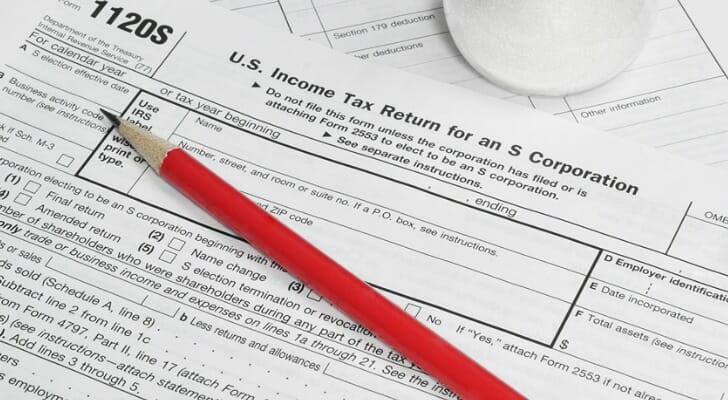
The S corporation is the only business tax status that lets you save on Social Security and Medicare taxes while avoiding double taxation. An LLC taxed as an S corp offers the benefits of a corporation while also providing flexibility on income treatment.
Tips for Business Taxes
- If you’re wondering if an LLC taxed as an S corp is the right path for your business, consider consulting with a financial advisor with tax or business planning expertise. Finding a financial advisor doesn’t have to be hard. SmartAsset’s free tool matches you with vetted financial advisors who serve your area, and you can have a free introductory call with your advisor matches to decide which one you feel is right for you. If you’re ready to find an advisor who can help you achieve your financial goals, get started now.
- Choosing an LLC and having it taxed as an S corp is a complex matter. While benefits often outweigh costs, you should talk to a professional tax advisor before choosing. However, SmartAsset’s tax guide can help you figure out some of the liabilities before you consult a pro.
Photo credit: ©iStock.com/Tinpixels, ©iStock.com/Ildo Frazao, ©iStock.com/hkuchera
Article Sources
All articles are reviewed and updated by SmartAsset’s fact-checkers for accuracy. Visit our Editorial Policy for more details on our overall journalistic standards.
- “Topic No. 751, Social Security and Medicare Withholding Rates | Internal Revenue Service.” Home, https://www.irs.gov/taxtopics/tc751. Accessed June 25, 2026.