 Written by
  Edited by
  Edited by
  Reviewed by

Working as an independent contractor or small business owner can bring tremendous freedom, but it can also bring headaches at tax time if you’re not careful. In addition to filing income taxes each April, you’re also required to set aside and pay money for estimated quarterly taxes. That’s standard if you receive Form 1099s from clients versus a W-2 from an employer and expect to owe $1,000 or more in taxes for the year.
A financial advisor can help you build a tax plan that keeps quarterly estimated payments manageable and avoids costly surprises at filing time.
What Taxes Do 1099 Workers Pay?
When you work on a 1099 contract basis, the IRS considers you to be self-employed. That means that in addition to income tax, you’ll need to pay self-employment tax. As of 2026, the self-employment tax is 15.3% of the first $168,600 in net profits, plus 2.9% of anything earned over that amount. The tax itself includes both Medicare and Social Security taxes.
Ordinarily, your employer would pay half of these taxes for you. But since you’re a 1099 independent contractor, not an employee, you’re responsible for paying the full amount yourself. Rather than waiting until the end of the year to pay self-employment and income tax, the IRS requires you to make estimated quarterly tax payments when you expect to owe more than $1,000 in taxes for the year.
Estimated quarterly tax payments are generally due according to this schedule:
- Payment 1: Due April 15 of the current year
- Payment 2: Due June 15 of the current year
- Payment 3: Due Sept. 15 of the current year
- Payment 4: Due Jan. 15 of the following year
If your state assesses income tax, you’ll also need to make estimated quarterly payments to your state tax authority. The deadlines follow the same schedule as the deadlines for federal estimated quarterly taxes.
How Much Should I Save for 1099 Taxes?
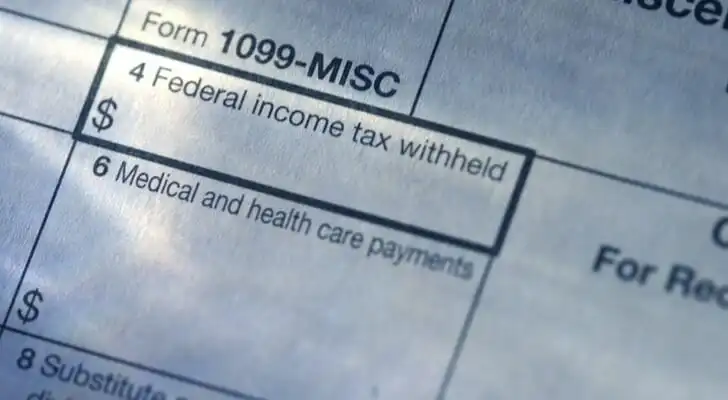
The amount you should consider saving for 1099 taxes depends on your income from self-employment and which tax bracket you expect to be in when you file your annual return. Generally, the amount you may need to set aside could range from 20% to 35% of your 1099 income, less any deductions that you’re eligible to claim.
Examples of expenses you might be able to deduct as a 1099 worker include:
- Office supplies
- Computer hardware or software
- Home office expenses
- Health insurance premiums you pay out of pocket
- Business travel expenses
- Advertising and marketing expenses
- Website expenses
It’s important to keep good records of any expenses you plan to deduct. In case the IRS decides to audit you later, you’ll have a paper trail to back up the deductions you claimed.
Because deductions and tax brackets can significantly affect how much you ultimately owe, estimating your total tax liability ahead of time can make it easier to avoid underpayment penalties.
Use our income tax calculator to project how your 1099 income and eligible deductions may influence your federal tax obligation and overall planning approach:
1099 Tax Examples
Let’s take a look at two tax scenarios for a single filer with a monthly self-employment income of $7,000 (totaling $84,000 annually). The examples will use 2026 federal and state tax brackets for New York State and Florida to show a comparison.
Federal Income Tax Calculation
First, let’s calculate the adjusted gross income (AGI):
- Total self-employed income: $84,000
- Self-employment taxable income (92.35% of total income): $84,000 × 92.35% = $77,574
- Self-employment tax (15.3% Rate): $77,574 × 15.3% = $11,869
- Adjusted gross income (AGI) after deducting half of self-employment tax: $84,000 – ($11,869 ÷ 2) = $84,000 – $5,934.50 = $78,066 (when rounded up to the nearest dollar)
Take note: The $78,066 AGI is the amount used to calculate federal income tax.
Now, let’s apply the 2026 federal tax brackets:
| Bracket | Taxable Amount | Rate | Tax Due |
|---|---|---|---|
| 10% | $12,400 | 10% | $1,240.00 |
| 12% | $50,400 – $12,400 = $38,000 | 12% | $4,560.00 |
| 22% | $78,066 – $50,400 = $27,666 | 22% | $6,086.52 |
| Total Federal Income Tax | $11,886.52 |
The total breakdown is:
- Self-Employment Tax: $11,869
- Federal Income Tax: $11,886.52
- Total Federal Taxes: $11,869 + $11,886.52 = $23,755.52
Now, let’s calculate the for New York. The Empire State has a progressive state income tax ranging from 4% to 10.9%. Applying the 2026 New York tax brackets to an income of $84,000, here is how much you would owe in taxes:
Based on the 2026 New York brackets confirmed earlier, the rates in the table are wrong. The correct 2026 single filer rates are 4%, 4.5%, 5.25%, 5.85% and 6.25% for the brackets that apply to $84,000 of income. Here is the corrected table with changes in bold:
| Bracket | Taxable Amount | Rate | Tax Due |
|---|---|---|---|
| 4% | $8,500 | 4% | $340.00 |
| 4.5% | $11,700 – $8,500 = $3,200 | 4.5% | $144.00 |
| 5.25% | $13,900 – $11,700 = $2,200 | 5.25% | $115.50 |
| 5.85% | $80,650 – $13,900 = $66,750 | 5.85% | $3,904.88 |
| 6.25% | $84,000 – $80,650 = $3,350 | 6.25% | $209.38 |
| Total NY State Tax | $4,713.76 |
Now, let’s compare the tax liability for both states:
New York
- Federal taxes: $23,755.52
- State taxes: $4,713.76
- Total taxes: $23,755.52 + $4,713.76 = $28,469.28
- Monthly tax payment: $28,469.28 ÷ 12 = $2,372.44
Florida
- Federal taxes: $23,755.52
- State taxes: $0 (No state income tax in Florida)
- Total taxes: $23,755.52
- Monthly tax payment: $23,755.52 ÷ 12 = $1,979.63
Based on the examples above, you can see that New York residents pay $28,469.28 in annual taxes ($2,372.44 per month). Florida residents, by comparison, pay $23,755.52 annually ($1,979.63 per month) because the Sunshine State has no income tax. This means that living in New York will cost you $4,713.76 more per year ($392.81 more per month) in taxes when compared with Florida.
Finally, you should note that being married and filing a joint return could also affect how much you should save for 1099 taxes. While it won’t affect your self-employment tax rate, since that’s calculated based on your 1099 earnings, it can affect your federal and state income tax rate. That could result in owing more money at tax time, even if you’ve been paying the appropriate amount of estimated quarterly taxes for your business income.
How to Set Aside Money for 1099 Taxes
Once you’ve estimated how much you’ll need to save each month for 1099 taxes, the next step is creating a system for saving that money. First, it’s helpful to set up a separate bank account to hold the money that you’ll use to pay your estimated taxes. That way, you don’t have to worry about accidentally spending any money.
There are different approaches you can take to save for 1099 taxes. For example, you can set aside a portion of each payment you receive as they come in. Or you can make one large transfer to your 1099 bank account at the end of each quarter.
You might wonder if you can’t just wait until the end of the year to pay your estimated taxes. For example, if you’re married you might want to wait and see if you’ll actually owe taxes for the year. While you could do that, you’re taking a gamble. When estimated quarterly payments are due, the IRS expects you to pay them. Failing to make those payments on time or pay enough toward your tax liability can result in penalties.
It’s possible to avoid penalties for underpaying estimated taxes, but only in limited circumstances. To avoid the penalty, you’d need to be able to show that:
- You owe less than $1,000 in tax after subtracting withholdings and credits.
- You paid at least 90% of the tax for the current year or 100% of the tax shown on your return for the prior year, whichever is smaller.
When you’re ready to pay your estimated taxes, you can do so online. The IRS allows you to create a taxpayer account and schedule payments directly from your bank account. If you also have to pay estimated taxes at the state level, you can check with your state tax agency to see if online payments are an option.
Remember to make note of each payment date and amount when paying estimated taxes. You’ll need this information to file your federal income tax return later.
How a Financial Advisor Can Help With 1099 Taxes
A financial advisor who works with self-employed clients can help estimate your total tax liability based on your income, deductions and filing status. This includes calculating both federal and state obligations, as well as self-employment tax, so you have a clear picture of what to set aside throughout the year.
Advisors can also help identify deductions you may be overlooking. Many 1099 workers miss legitimate business expenses or fail to account for deductions like the qualified business income deduction, retirement plan contributions, or health insurance premiums. A thorough review of your expenses can reduce your taxable income and lower your quarterly payments.
Structuring estimated quarterly payments is another area where guidance matters. Underpaying can lead to penalties, while overpaying ties up cash you could be using elsewhere. An advisor can help you find the right balance based on your income patterns, especially if your earnings fluctuate from month to month or season to season.
Long-Term and Retirement Planning
For self-employed individuals earning higher incomes, tax planning often extends beyond quarterly estimates. An advisor can evaluate whether forming an S-corp or LLC makes sense for your situation, which may reduce the amount subject to self-employment tax.
Retirement planning is closely tied to tax strategy for 1099 workers. Options like a SEP IRA, Solo 401(k) or SIMPLE IRA allow you to reduce taxable income while building long-term savings. An advisor can help determine which account type fits your income level and contribution goals.
As your self-employment income grows or your personal circumstances change, your tax strategy should adjust accordingly. An advisor can help you revisit your plan each year to account for changes in income, new deductions, shifts in tax law or life events like marriage or homeownership that affect your overall tax picture.
Deductions That Can Lower Your 1099 Tax Bill
Most 1099 workers know they can write off business expenses. What fewer realize is that some of the largest deductions available have nothing to do with what they spend on their business and everything to do with how their income is structured.
Many sole proprietors and single-member LLC owners qualify for the qualified business income (QBI) deduction, worth up to 20% of net self-employment income. Eligibility phases out at higher income levels for certain service businesses, so confirming whether it applies to your specific situation before building it into your estimates matters.
Workers who pay their own health insurance premiums and have no access to an employer-sponsored plan, including through a spouse, can deduct the full annual cost directly from adjusted gross income without itemizing. That distinction matters because this deduction reduces the base used to calculate income tax regardless of how you file.
Putting money into a retirement account is one of the few moves that simultaneously builds long-term savings and cuts this year’s tax bill. A SEP IRA allows contributions of up to 25% of net self-employment income, up to the 2026 annual cap. A Solo 401(k) can accommodate even larger combined contributions for higher earners. Either option reduces taxable income dollar for dollar, with additional savings in states that tax income.
A dedicated home workspace qualifies for a deduction as long as the space is used regularly and exclusively for business. The simplified method applies a flat dollar amount per square foot up to a set maximum. The regular method calculates the actual share of home costs attributable to the workspace, which typically produces a larger deduction but requires records of rent or mortgage interest, utilities and insurance throughout the year. Owners of the property should also be aware that this method can trigger depreciation recapture when the home is eventually sold.
One deduction that runs quietly in the background is the offset for self-employment tax itself. Because self-employed workers pay both the employee and employer portions of payroll tax, the IRS allows half of that annual bill to be deducted from adjusted gross income. In the $84,000 example used earlier, self-employment tax came to $11,869, making the deductible portion $5,934.50. That amount reduces taxable income before the federal income tax calculation begins. It processes automatically when you file Schedule SE, but accounting for it when estimating quarterly payments throughout the year keeps those estimates closer to what you will actually owe at filing.
Bottom Line

Having to pay 1099 taxes can take some getting used to if you’re just getting started as a freelance or independent contractor. The most important things to know are how to estimate your tax liability and when to get those payments in. Understanding your obligations for paying estimated taxes can help you avoid running afoul of the IRS.
Tips for Financial Planning
- Consider talking to your financial advisor about what’s involved in paying 1099 taxes and how much you should set aside each month. Finding a financial advisor doesn’t have to be hard. SmartAsset’s free tool matches you with vetted financial advisors who serve your area, and you can have a free introductory call with your advisor matches to decide which one you feel is right for you. If you’re ready to find an advisor who can help you achieve your financial goals, get started now.
- If you’ve filed your tax return and you find that you still owe, despite having made all of your estimated quarterly tax payments it’s important to know what to do next. Consider these tips on what to do if you owe money to the IRS.
©iStock.com/Prostock-Studio, ©iStock.com/Kameleon007, ©iStock.com/Dobrila Vignjevic