 Written by
  Edited by

If you give someone cash or property valued at more than the 2026 gift tax exclusion limit of $19,000 ($38,000 for married joint filers), you’ll have to fill out Form 709 for gift tax purposes. But don’t fret. This doesn’t always mean you’ll owe an actual tax. The government requires this to keep track of your lifetime gift and estate tax exemption. It’s only when you use up the large lifetime exemption that you would owe an out-of-pocket tax. Still, filling out Form 709 can get complicated. This article will walk you through the process step-by-step. It’ll also help you determine if you need to fill out Form 709 in the first place.
If you’re looking help with specific areas of your finances, including tax planning, consider speaking with a financial advisor.
What Counts Toward the Gift Tax?
The IRS defines a gift as virtually anything of value that you give to another individual or entity without expecting anything of equal or lesser value in return. It doesn’t have to be cold, hard cash, either. This covers several types of asset and property. That includes a house, car, jewelry and more. It also includes several types of financial accounts such as an investment portfolio.
The following may also be considered gifts:
- A hefty loan you gave someone with zero interest
- Forgiving large debt that’s owed to you
- Gifting money out of retirement accounts
Nonetheless, the government does give you some wiggle room. Giving money to the following individuals or institutions is never considered a taxable gift:
- Spouse who’s a U.S. citizen (if spouse is not a citizen, there is a $190,000 limit)
- Care provider to cover someone else’s qualified medical expenses
- Educational institution to cover tuition only
- Political organizations
So you can give as much as you want to those individuals and institutions for the year without needing to fill out Form 709 or pay a gift tax.
But even if you think you’ve given away a lot in taxable gifts, you may not need to fill out Form 709 or pay a tax. That’s because of the gift tax limits.
What Is the Annual Gift Tax Exclusion?

For tax year 2026, you may give someone cash or property valued at up to $19,000 without needing to fill out Form 709. The exclusion applies per person. So you can give your son, daughter and grandchild $19,000 each without catching Uncle Sam’s attention. For married couples making joint gifts to a third party, the annual exclusion for the 2026 tax year is $38,000.
But once you transfer a taxable gift valued above those limits to any one person, you have to fill out Form 709. Officially, it’s called the United States Gift (and Generation-Skipping Transfer) Tax Return.
If you make a joint gift with your spouse, each individual must fill out a Form 709. There is no joint Form 709.
However, you won’t need to pay an actual tax unless you go beyond your lifetime gift and estate tax exemption. The Trump tax plan, known as the Tax Cuts and Jobs Act (TCJA), raised those limits considerably in 2018. Currently, the lifetime exemption is $15 million per individual for tax year 2026 (up from $13.99 million in 2025).
How to Fill Out Form 709
If you’ve figured out you must fill out Form 709, follow the instructions below.
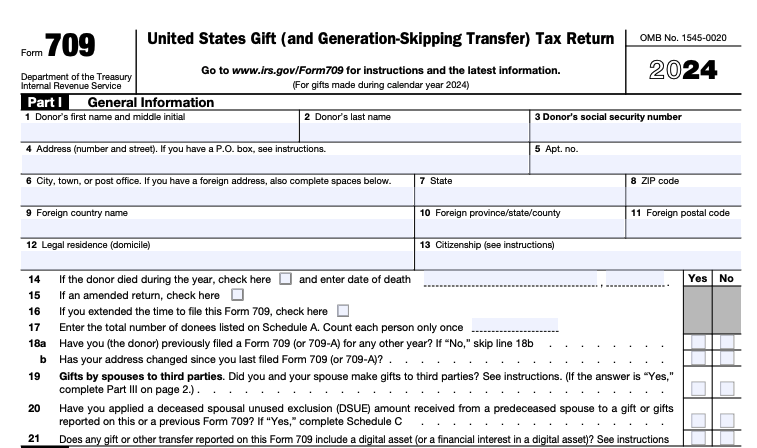
First, complete the General Information section on part one of the form. Line 12 would also allow you to check off on whether you and your spouse made joint gifts for the tax year. If not, you may skip lines 13 through 18. Note that your spouse must also sign Form 709 in the appropriate spot if you made joint gifts. But each would have to fill out his or her own form.
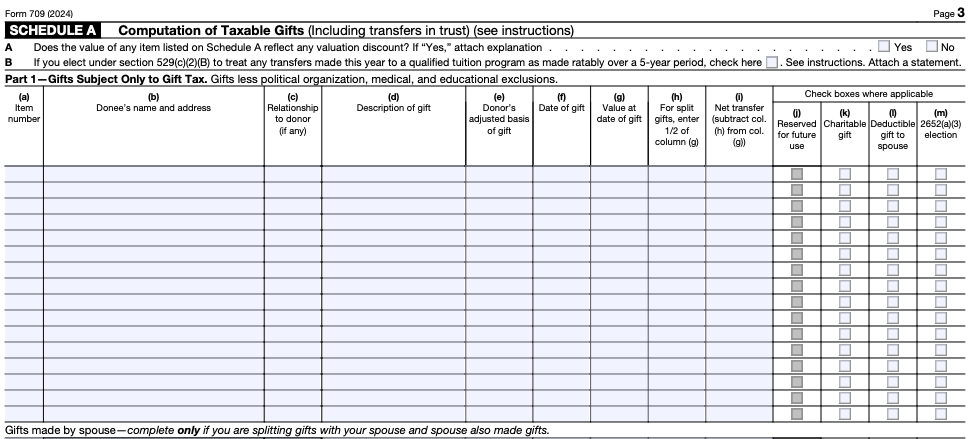
Report the gifts on Schedule A: Computation of Taxable Gifts. Here, you’d provide information such as a description of the gift, the recipient, and its value at the time it was made.
You may also report transfers subject to the gift tax and/or generation-skipping transfer tax if applicable. In addition, you’d report transfers made to trusts if any.
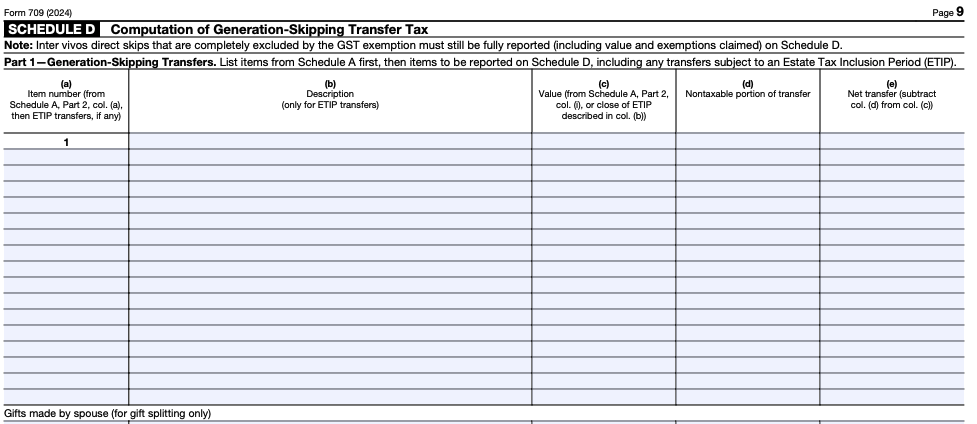
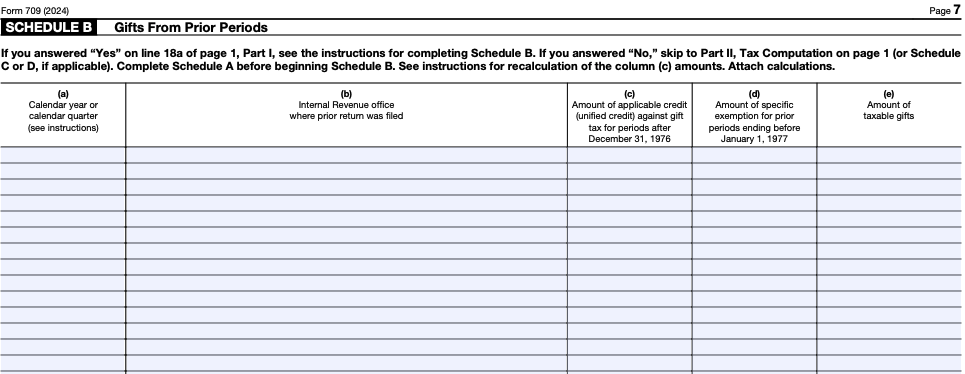
If any applies to you, complete the sections titled Gifts From Prior Periods, Deceased Spousal Unused Exclusion Amount and Computation of Generation Skipping Transfer Tax. These are Schedule B, C, and D, respectively.
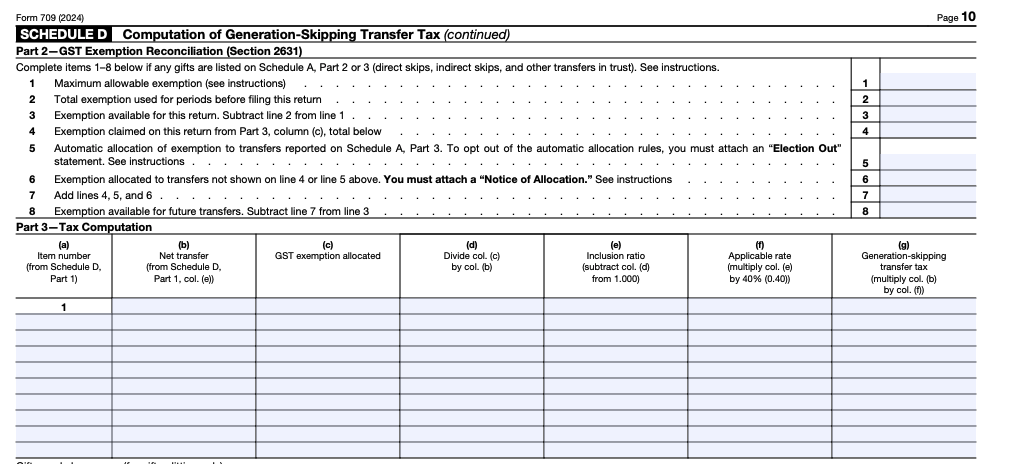
Complete Part 3, known as “Tax Computation.” It is located on the first page of Form 709. Refer to the “Table for Computing Gift Tax” under instructions to calculate the tax on the amount of reported gift or gifts. You may apply your lifetime gift and estate tax exemption, also known as the unified credit. So you don’t have to pay an out-of-pocket tax if you use this exemption. It will, however, reduce how much you can give and transfer out of your estate tax-free in the future.
Finally, sign and date the form.
Before you file your return, use our income tax calculator to estimate what you may owe or receive.
Income Tax Calculator
Calculate your federal, state and local taxes for the 2025 tax year.
Your 2025 Total Income Taxes
Federal Income & FICA Taxes
State Taxes
Local Taxes
About This Calculator
Our income tax calculator calculates your federal, state and local taxes based on several key inputs: your household income, location, filing status and number of personal exemptions.
How Income Taxes Are Calculated
-
First, we calculate your adjusted gross income (AGI) by taking your total household income and reducing it by certain items such as contributions to your 401(k).
-
Next, from AGI we subtract exemptions and deductions (either itemized or standard) to get your taxable income. Exemptions can be claimed for each taxpayer.
-
Based on your filing status, your taxable income is then applied to the tax brackets to calculate your federal income taxes owed for the year.
-
Your location will determine whether you owe local and / or state taxes.
When Do We Update? - We check for any updates to the latest tax rates and regulations annually.
Customer Service - If you would like to leave any feedback, feel free to email info@smartasset.com.
Assumptions
Deductions
- "Other Pre-Tax Deductions" are not used to calculate state taxable income.
Credits
- The only federal credit automatically calculated is the Savers Credit, depending on your eligibility.
- We do not apply any refundable credits, like the Child Tax Credit or Earned Income Tax Credit (EITC).
- We do not apply state credits in our calculations.
Itemized Deductions
- If itemizing at the federal level, you may need to itemize at the state level too. Some states don't allow itemized deductions, which is accounted for in our calculations.
- When calculating the SALT deduction for itemized deductions, we use state and local taxes, and we assume your MAGI.
- We assume that there is no cap to itemized deductions, if a state allows them.
- We do not categorize itemized deductions (such as medical expenses or mortgage interest), which could be subject to specific caps per state.
Local Tax
- Depending on the state, we calculate local taxes at the city level or county level. We do not include local taxes on school districts, metro areas or combine county and city taxes.
- With the exception of NYC, Yonkers, and Portland/Multnomah County, we assume local taxes are a flat tax on either state taxable income or gross income.
Actual results may vary based on individual circumstances and changes in tax laws or IRS regulations. Estimates provided by this calculator do not guarantee income tax amounts or rates. Past performance is not indicative of future results.
SmartAsset.com does not provide legal, tax, accounting or financial advice (except for referring users to third-party advisers registered or chartered as fiduciaries ("Adviser(s)") with a regulatory body in the United States). Articles, opinions and tools are for general informational purposes only and are not intended to provide specific advice or recommendations for any individual. Users should consult their accountant, tax advisor or legal professional to address their particular situation.
Bottom Line
Unless you made a taxable gift valued at more than $19,000 to an individual or entity in 2026 or in 2025, you don’t need to fill out Form 709. If you did, you may just need to report the gift. You won’t owe an out-of-pocket tax until you’ve given more than your lifetime gift and estate tax exemption. That currently stands at $15 million for tax year 2026 and $13.99 million for tax year 2025.
Additional Tax Filing Tips

- Some financial advisors can help you optimize your tax strategy for your financial goals. Finding a financial advisor doesn’t have to be hard. SmartAsset’s free tool matches you with vetted financial advisors who serve your area, and you can have a free introductory call with your advisor matches to decide which one you feel is right for you. If you’re ready to find an advisor who can help you achieve your financial goals, get started now.
- If you’re investing in a 529 college savings plan, you have some special gift tax exemptions. We cover these in our study on how to give money to students and avoid gift tax.
- If you don’t feel like filing taxes by hand, you can always use tax software to get it done and avoid mistakes.
Photo credit: ©iStock.com/Andrei Barmashov, ©iStock.com/Andrii Yalanskyi, ©iStock.com/LIgorko