 Written by
  Edited by
  Edited by
  Reviewed by

Estate tax rates in Washington state are progressive and range from 10% to 20%. The estate tax in Washington applies to estates worth $3,076,000 and up, as of 2026. If you’re a Washington resident and you’re starting to think about estate planning, this guide takes a deep dive into everything you need to know.
A financial advisor can help you navigate estate and tax planning for your beneficiaries.
Washington Estate Tax Exemption
The 2026 threshold for the estate tax in Washington is $3,076,000. So if a person’s estate is equal to less than $3,076,000, then it won’t be taxed by Washington state upon the person’s death. If the estate is equal to more than $3,076,000, then the first $3,076,000 won’t be subject to the estate tax, but the tax will be applied to the value of the estate above that threshold. This threshold drops to $3,000,000 in 2027. 1
The Washington estate tax is not portable for married couples. When both spouses die, only one exemption of $3,076,000 applies.
Washington Estate Tax Rate
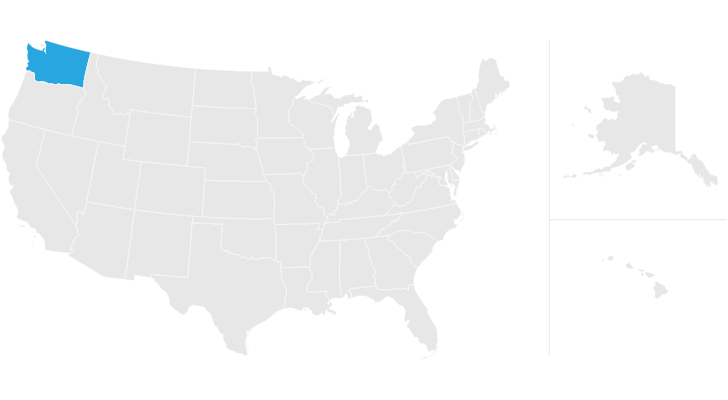
Washington’s estate tax is progressive, with a series of increasing rates applying as the value of the estate gets higher.
You can find your taxable estate bracket in the chart below. The base taxes paid is what you owe on money that falls below your bracket. Then see how much your taxable estate exceeds the bottom limit of your bracket. Multiply that number by the marginal rate. Finally, add that amount to the base taxes and you’ll have your total estate tax bill.
Here’s an example: Let’s say your total estate is worth $7,883,000. With the $3,076,000 exemption, your taxable estate equals $4,807,000. Find where that total falls on the chart below. The base taxes for you brackets then are $550,000, so keep this number in mind. The bottom of the threshold is $4 million, which you subtract from $4.807 million and get $807,000. That figure multiplied by the marginal rate of 18% is $145,260. That sum ($145,260) plus the base taxes ($550,000) equals $695,260, which is your total Washington estate tax burden.
Washington Estate Tax Rates 2
| Taxable Estate* | Base Taxes Paid | Marginal Rate | Rate Threshold** |
|---|---|---|---|
| $0 – $1,000,000 | $0 | 10% | $0 |
| $1,000,000 – $2,000,000 | $100,000 | 14% | $1,000,000 |
| $2,000,000 – $3,000,000 | $240,000 | 15% | $2,000,000 |
| $3,000,000 – $4,000,000 | $390,000 | 16% | $3,000,000 |
| $4,000,000 – $6,000,000 | $550,000 | 18% | $4,000,000 |
| $6,000,000 – $7,000,000 | $910,000 | 19% | $6,000,000 |
| $7,000,000 – $9,000,000 | $1,100,000 | 19.5% | $7,000,000 |
| Over $9,000,000 | $1,490,000 | 20% | $9,000,000 |
*The taxable estate is the total above the 2026 exemption of $3,076,000.
**The rate threshold is the point at which the marginal estate tax rate goes into effect.
What Is the Estate Tax?
Governments levy this tax on the estate of a recently deceased person before it passes their money or property on to their heirs. Sometimes called the “death tax,” this tax only applies to estates worth a particular amount, which varies by state. Don’t confuse it with the inheritance tax, which some states apply to the money inherited by beneficiaries.
Washington Inheritance Tax
While there is no inheritance tax in Washington, but another state’s inheritance tax could apply to you. For example, in Pennsylvania, the inheritance tax applies if the dead person lived there, even if the inheritor lives out of state.
Washington Gift Tax
Washington has no gift tax, so you’ll only be subject to the federal gift tax, which says you can give up to $19,000 to individuals without any tax implications in 2026. Any amount gifted over the threshold counts against your 2026 lifetime exemption of $15 million. 3
Federal Estate Tax
In addition to the Washington estate tax, there is a federal estate tax you may have to pay, but the exemption is much higher. The federal estate tax exemption is $15 million in 2026. It is portable between spouses. This means that by taking certain legal steps, a couple can protect up to $30 million from estate taxes.
The top federal estate tax rate is 40%. By following the same method described in the Washington Estate Tax Rate section and using the table below, you can figure out your federal estate tax burden.
Federal Estate Tax Rates 4
| Taxable Estate* | Base Taxes Paid | Marginal Rate | Rate Threshold** |
|---|---|---|---|
| $1 – $10,000 | $0 | 18% | $1 |
| $10,000 – $20,000 | $1,800 | 20% | $10,000 |
| $20,000 – $40,000 | $3,800 | 22% | $20,000 |
| $40,000 – $60,000 | $8,200 | 24% | $40,000 |
| $60,000 – $80,000 | $13,000 | 26% | $60,000 |
| $80,000 – $100,000 | $18,200 | 28% | $80,000 |
| $100,000 – $150,000 | $23,800 | 30% | $100,000 |
| $150,000 – $250,000 | $38,800 | 32% | $150,000 |
| $250,000 – $500,000 | $70,800 | 34% | $250,000 |
| $500,000 – $750,000 | $155,800 | 37% | $500,000 |
| $750,000 – $1,000,000 | $248,300 | 39% | $750,000 |
| Over $1,000,000 | $345,800 | 40% | $1,000,000 |
*The taxable estate is the total above the 2026 exemption of $15 million.
**The rate threshold is the point at which the marginal estate tax rate kicks in.
Overall Washington Tax Picture
Washington is a mixed bag when it comes to taxes. To start, Washington has no state income tax, meaning that Social Security, retirement income, pensions and other income sources are not taxed. This makes it one of the friendlier states for retirees. If you’re new to the Evergreen State, you can use our Washington paycheck calculator to see how that lack of state income tax may affect your take home pay.
The state does have very high sales taxes, however. The statewide sales tax rate is 6.5% and when county rates are included, rates average 9.51%. Property taxes in Washington are relatively low by national standards, as the average effective property tax rate is 0.79%.
How an Advisor Can Help Navigate Washington State Estate Taxes
One of the most immediate planning considerations is that Washington’s estate tax exemption is not portable between spouses. Unlike the federal exemption, which can be transferred to a surviving spouse, Washington requires each spouse to use their own exemption independently. For married couples with combined estates above $3,076,000, this non-portability can result in a significant state tax bill. An advisor can help structure asset ownership between spouses in a way that takes advantage of both exemptions.
Gifting is one of the most straightforward tools for reducing a taxable estate in Washington. The state has no gift tax, and the federal annual exclusion allows $19,000 per recipient per year. An advisor can build a systematic gifting plan that draws down the estate gradually over time, calibrated so that gifts are made from surplus rather than funds you may need later.
For estates with significant appreciated assets, the interaction between Washington’s estate tax and the federal stepped-up basis rules creates a specific planning opportunity. Assets that receive a step-up in basis at death avoid capital gains tax on appreciation that occurred during the owner’s lifetime. A financial advisor can help you identify which assets are most valuable to pass through the estate for the basis step-up versus which are better candidates for lifetime transfers or trust structures that reduce the taxable estate.
Washington’s progressive rate structure, which reaches 20% on estates above $9 million, makes the marginal cost of inaction meaningful for larger estates. Irrevocable trust structures, charitable remainder trusts and other vehicles can remove assets from the taxable estate while serving broader financial goals. An advisor can model the long-term tax savings of each approach against what you would give up in terms of control or access, so the decision is based on actual numbers rather than general principles.
Bottom Line

Washington’s lack of state income tax and state gift tax creates favorable conditions for estate planning strategies that would cost more elsewhere. Because estate tax exemptions and rates change, confirming the correct figures for the applicable date of death is critical rather than relying on historical numbers. An advisor familiar with Washington’s specific tax landscape can identify opportunities a generalist might miss.
“Living in a state with an estate tax presents a unique challenge,” said Matthew Hofacre, MSPFP, CFP®, EA. “Getting assets out of your taxable estate generally requires you to lose control or access to those assets. You should work with a tax professional to analyze the tradeoffs of including or removing an asset from your taxable estate.” said Matthew Hofacre, MSPFP, CFP®, EA.
Matthew Hofacre, MSPFP, CFP®, EA provided the quote used in this article. Please note that Matthew is not a participant in SmartAsset AMP, is not an employee of SmartAsset and has been compensated. The opinion voiced in the quote is for general information only and is not intended to provide specific advice or recommendations.
Estate Planning Tips
- If you think you need help with estate planning or any other kind of financial planning, you may want professional help from a financial advisor. Finding an advisor doesn’t have to be hard. SmartAsset’s free tool matches you with vetted financial advisors who serve your area, and you can interview your advisor matches at no cost to decide which one is right for you. If you’re ready to find an advisor who can help you achieve your financial goals, get started now.
- If you want to make sure everything is set for when you do eventually die, a living trust might be the way to go. This will let you transfer the control of some of your assets to a trustee.
Photo credit: ©iStock.com/PeopleImages, SmartAsset, ©iStock.com/Gwengoat
Article Sources
All articles are reviewed and updated by SmartAsset’s fact-checkers for accuracy. Visit our Editorial Policy for more details on our overall journalistic standards.
- “Estate Tax Tables | Washington Department of Revenue.” Washington Department of Revenue, https://dor.wa.gov/taxes-rates/other-taxes/estate-tax-tables. Accessed May 9, 2026.
- “Estate Tax Tables | Washington Department of Revenue.” Washington Department of Revenue, https://dor.wa.gov/taxes-rates/other-taxes/estate-tax-tables. Accessed May 9, 2026
- “IRS Releases Tax Inflation Adjustments for Tax Year 2026, Including Amendments from the One, Big, Beautiful Bill | Internal Revenue Service.” Home, https://www.irs.gov/newsroom/irs-releases-tax-inflation-adjustments-for-tax-year-2026-including-amendments-from-the-one-big-beautiful-bill. Accessed May 9, 2026.
- “Instructions for Form 706 (09/2025) | Internal Revenue Service.” Home, Sept. 1, 2025, https://www.irs.gov/instructions/i706.