 Written by
 Edited by
 Reviewed by


Arkansas does not levy an estate tax. The federal government does have an estate tax, though, and Arkansas residents may be subject to that if the value of their estate is high enough. This guide is for residents of The Natural State who are starting to think about estate planning and want to make sure everything is taken care of when they are gone.
Do you want help with estate planning or another financial planning matter? Speak with a financial advisor today.
Arkansas Estate Tax
Arkansas has no estate tax. It is one of 38 states without a state-level estate tax.
What Is the Estate Tax?
The estate tax – sometimes referred to as the “death tax” – is a tax levied on the estate of a person who is recently deceased. It is applied before the money has been passed on to a person’s heirs and is only relevant for estates that reach a certain threshold.
The inheritance tax is different from the estate tax. Beneficiaries are responsible for paying inheritance tax on the money or assets they receive, whereas the estate of the deceased is responsible for paying estate taxes.
Arkansas Inheritance and Gift Tax
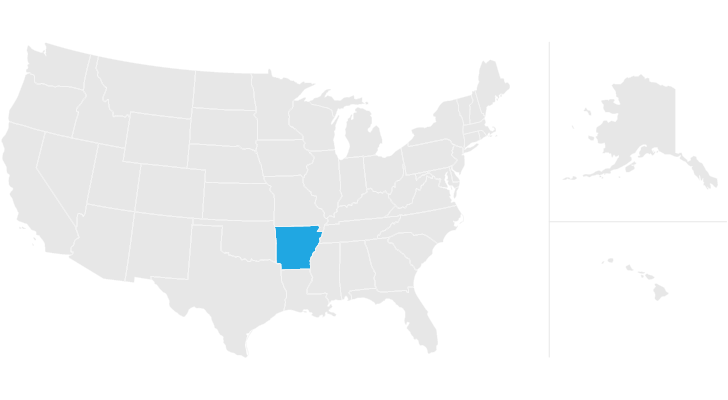
Arkansas also has no inheritance tax. Inheritance laws of other states may apply to you, though, if you inherit money or assets from someone who lives in a state that has an inheritance tax. The Pennsylvania inheritance tax, for instance, applies to out-of-state inheritors. If you receive an inheritance from someone living out-of-state, make sure to check the local laws in your grantor’s state to see if you owe inheritance tax.
Arkansas also has no gift tax. The federal gift tax exclusion is $19,000 per gift recipient for gifts in 2026, the same as for 2025. If you give more than that amount to any one person in a given year, you must report it to the IRS. Any amount gifted over the exclusion also counts against your lifetime gift tax exemption of $15 million and decreases your federal estate tax exemption, described below.
Federal Estate Tax
Arkansas doesn’t have an estate tax, but the federal estate tax may still apply. The federal estate tax exemption is $15 million in 2026, up from $13.99 million in 2025.
Married couples can transfer their exemption to each other. If a deceased spouse’s unused exclusion is properly elected for portability, the surviving spouse may be able to use that amount in addition to their own exclusion.
This can allow a married couple to shelter up to $30 million under the 2026 basic exclusion amounts, assuming the applicable requirements are met.
If your estate exceeds the exemption, the tax rate is progressive, with a top rate of 40%. Because the $15 million exemption is well above the $1 million level where the top rate begins, any amount above the exemption is effectively taxed at 40%.
For example, if you have a $21.82 million estate and no spouse, subtracting the $15 million exemption leaves $6.82 million subject to tax. At 40%, the federal estate tax would be about $2.728 million ($6.82 million × 40%), before considering other applicable credits or adjustments.
The table shows the federal estate tax rates:
| Taxable Estate* | Marginal Rate | Federal Estate Tax Owed |
|---|---|---|
| $1 – $10,000 | 18% | 18% of taxable estate |
| $10,001 – $20,000 | 20% | $1,800 + 20% of taxable estate over $10,000 |
| $20,001 – $40,000 | 22% | $3,800 + 22% of taxable estate over $20,000 |
| $40,001 – $60,000 | 24% | $8,200 + 24% of taxable estate over $40,000 |
| $60,001 – $80,000 | 26% | $13,000 + 26% of taxable estate over $60,000 |
| $80,001 – $100,000 | 28% | $18,200 + 28% of taxable estate over $80,000 |
| $100,001 – $150,000 | 30% | $23,800 + 30% of taxable estate over $100,000 |
| $150,001 – $250,000 | 32% | $38,800 + 32% of taxable estate over $150,000 |
| $250,001 – $500,000 | 34% | $70,800 + 34% of taxable estate over $250,000 |
| $500,001 – $750,000 | 37% | $155,800 + 37% of taxable estate over $500,000 |
| $750,001 – $1 million | 39% | $248,300 + 39% of taxable estate over $750,000 |
| Over $1 million | 40% | $345,800 + 40% of taxable estate over $1 million |
*These rates apply to the full taxable estate. A credit equal to the tax on the first $15 million cancels out the tax on that amount, so estates above the 2026 exemption effectively pay 40% on every dollar over $15 million.
When an Arkansas Estate May Need to File Form 706
Arkansas does not impose its own estate tax, but an estate can still have federal filing obligations. For someone who dies in 2026, the executor generally must file Form 706 if the estate exceeds the federal filing limit after taking into account the value of the estate, prior taxable gifts and any relevant specific exemption. For 2026, that federal limit is $15 million.
Form 706 can also matter when an estate falls below that amount. If a married person dies with part of their federal estate and gift tax exclusion unused, the executor may file the return to make a portability election for the surviving spouse.
Through portability, part of the first spouse’s unused federal exclusion may remain available for the surviving spouse’s later gifts or estate. Tax rules refer to this carryover amount as DSUE.
An estate seeking that treatment generally has to submit Form 706 under the applicable portability filing rules, even when its value is low enough that a return would not otherwise be required.
For example, consider an Arkansas resident who dies in 2026 owning an $8 million estate and who made no prior taxable gifts. Based on those facts alone, the estate would generally fall below the federal filing level.
If the person was married, however, filing Form 706 may still be worth considering so that any unused federal exclusion can potentially remain available to the surviving spouse. The value of doing so depends on factors such as the spouses’ combined wealth, previous gifts and the terms of their estate plan.
Bottom Line

Arkansas is a fairly tax-friendly state for retirees. The state does not tax Social Security income. It does partially tax withdrawals from retirement accounts, like 401(k) plans and IRAs. The same is true for income from private or public pensions. Income tax in Arkansas is progressive, with a top rate of 3.9%. Property taxes in Arkansas are fairly low in comparison to the rest of the nation, with an effective rate of just 0.52%. Arkansas also has no estate tax, so only estates above the $15 million federal exemption would owe estate tax in 2026.
“It’s extremely rare that a decedent would be subject to federal estate tax given the large federal exemption. However, that can change, so it’s important any deceased individual who was married at the time of death files a Form 706, not because they are subject to estate tax, but to properly claim the portability election,” said Matthew Hofacre, MSPFP, CFP®, EA.
Matthew Hofacre, MSPFP, CFP®, EA provided the quote used in this article. Please note that Matthew is not a participant in SmartAsset AMP, is not an employee of SmartAsset and has been compensated. The opinion voiced in the quote is for general information only and is not intended to provide specific advice or recommendations.
Estate Planning Tips
- Estate planning can be complex, so you may want some help from a professional. Finding a financial advisor doesn’t have to be hard. SmartAsset’s free tool matches you with vetted financial advisors who serve your area, and you can have a free introductory call with your advisor matches to decide which one you feel is right for you. If you’re ready to find an advisor who can help you achieve your financial goals, get started now.
- There are a number of options for how to plan your estate, including wills and living trusts. Your financial advisor can help you figure out which is the best choice for you.
Photo credit: ©iStock.com/12ee12, SmartAsset, ©iStock.com/skynesher