 Written by
  Edited by
  Edited by
Planning for retirement requires us to consider not only how to build wealth but how to protect it. Employers offer 401(k)s to address the first need, but careful planning can help us ensure our money stays with us. While you can’t get a 401(k) tax deduction, pre-tax contributions to 401(k) plans lower your taxable income and reduce your tax liability in a give year.
A financial advisor could help you put a tax strategy together for your investments and retirement savings.
How 401(K) Contributions Can Reduce Your Tax Liability
When you make contributions to your 401(k), you do it on a pretax basis. Essentially, some of the money earned through your work goes directly into the account before taxes can take a bite out of it. That reduction from your take-home pay shrinks your taxable income. As a result, you pay less income tax.
For example, let’s say you file single, earn a salary of $100,000 and decide to take advantage of your employer’s 401(k) matching program. They offer a dollar-for-dollar match up to 3% of your annual salary, so you decide to contribute 5% of your own earnings, plus the 3% your employer offers. Together, you contribute a total of 8% of your annual salary, which is 8,000.
Remember, only the portion of your total contribution that you personally made reduces your taxable income. As a result, a 401(k) contribution of 5% of your salary lowers your taxable income by $5,000 to $95,000.
401(k) Distributions Timing to Cut Taxes
The timing of your 401(k) distributions can make a significant difference in how much tax you ultimately pay. Because withdrawals from a traditional 401(k) are taxed as ordinary income, taking money out during high-income years can push you into a higher tax bracket and increase your overall tax burden. Many retirees strategically delay withdrawals until their income drops, often after they stop working, when they may qualify for a lower tax bracket. This approach can help stretch retirement savings further by reducing the share lost to taxes.
Required minimum distributions (RMDs) add another layer of timing strategy. Starting at age 73 under current rules, you must begin taking annual withdrawals whether you need the income or not. Planning ahead can help you avoid large, mandatory withdrawals later that could spike your taxable income. Some retirees choose to take smaller distributions earlier or convert portions of their 401(k) to a Roth IRA before RMD age, helping them manage taxes more predictably over time.
Ultimately, thoughtful withdrawal timing can smooth out your taxable income and reduce the risk of unnecessary tax spikes. By coordinating withdrawals with Social Security benefits, investment income and other tax-sensitive factors, you can build a more efficient retirement income plan. A financial advisor can help you model different timing strategies and choose the one that minimizes taxes while keeping your long-term financial goals on track.
How Roth 401(k)s Cut Your Tax Liability in Retirement
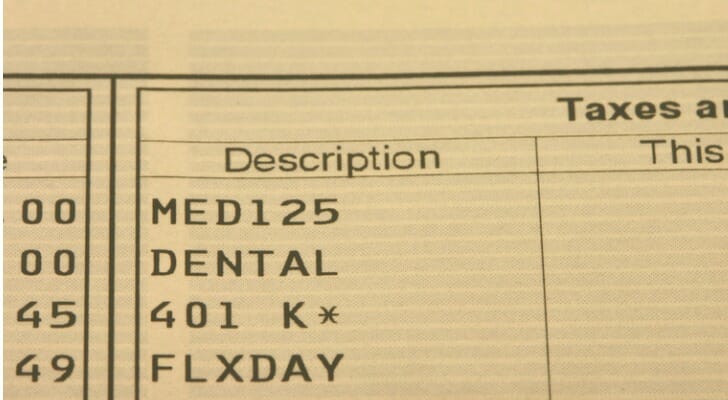
Roth 401(k)s come with many of the perks traditional 401(k)s provide. Like the latter, employers sponsor these retirement plans. However, you use after-tax money to contribute to them instead of pretax money. As a result, they have no impact on your current taxable income. So, you continue to pay taxes on your full paycheck as you contribute.
However, you won’t face any income taxes when you withdraw the money in the future, meaning your investment earnings grow tax-free (assuming the withdrawals are considered “qualified“).
Because of this, the tax savings you realize with a Roth 401(k) depend on your current and future tax rates. It’s possible to earn more in your retirement, putting you in a higher tax bracket. If so, a Roth 401(k) would benefit you since you avoid paying higher income taxes on your withdrawals. In contrast, if you believe your income tax will drop in retirement, you’re likely better off with a traditional 401(k).
You also have the option to use both. Taxpayers can fund a traditional, tax-deferred 401(k) as well as a Roth version. However, keep in mind that both normally require you to be at least 59 ½ to withdraw without penalty.
Other Tax Benefits for Saving
If you’re focused on lowering your tax bill, there is another way. The Saver’s Credit, originally called the Retirement Savings Contributions Credit, gives eligible taxpayers a break. Specifically, it’s designed for those who earn a low to moderate income. Essentially, the Saver’s Credit lowers your taxable income by a percentage of your 401(k) contribution. This tax break is in addition to the tax savings your contribution already provides.
Depending on your filing status and adjusted gross income, you can claim it for 10%, 20% or 50% of the first $2,000 you put into your retirement account annually. So, the maximum amount you can claim through the credit is $200, $400 and $1,000, respectively. However, for married couples filing jointly the maximum they can claim is $2,000.
Full-time students and dependents are not eligible for this credit, and you must meet the income requirements. For 2026, the maximum adjusted gross income (AGI) limits for the Saver’s Credit are $80,500 (up from $79,000 in 2025) for couples filing jointly, $60,375 (up from $59,250 in 2025) for a head of household and $40,250 (up from $39,500 in 2025) for all other taxpayers.
In addition to a 401(k), you can claim the Saver’s Credit on other accounts, such as a 403(b), 457 plan, simple IRA or SEP IRA.
Bottom Line

While 401(k) contributions are not technically tax deductible, these retirement accounts offer significant tax benefits. Contributing pretax into a traditional 401(k) lets you lower your taxable income and defer taxes on your retirement savings until you withdraw it. At that time, you’ll pay income taxes on the money. If you believe you’ll earn more in your later years and be in a higher tax bracket, a Roth 401(k)s may be a good option, since it allows your money to grow tax-free. There are also other ways to reduce your taxable income, such as making charitable donations to nonprofits.
Tips for Retirement Planning
- What do your plans look like for retirement? Will your 401(k) be enough to support you when you stop working? These are tough questions, but a financial advisor can guide you through them. Finding a financial advisor doesn’t have to be hard. SmartAsset’s free tool matches you with vetted financial advisors who serve your area, and you can have a free introductory call with your advisor matches to decide which one you feel is right for you. If you’re ready to find an advisor who can help you achieve your financial goals, get started now.
- A 401(k) can be a great way to build funds to support your retirement. But retirees are often caught off guard by unexpected costs like emergencies and medical bills. These can drain your reserve of funds. So, every working adult should consider planning for these potential healthcare expenses. A health savings account (HSA) is one way to do that. They’re tax-deferred like 401(k)s but lack taxes on qualified withdrawals. You can check out our guide on HSAs to see if they’re right for you.
Photo credit: ©iStock.com/DNY59, ©iStock.com/RBFried, ©iStock.com/alfexe