 Written by
  Edited by
  Edited by

Retiring in Norway offers an exceptional quality of life amidst a unique blend of breathtaking landscapes. However, it comes with specific considerations. The Scandinavian nation consistently ranks among the world’s happiest countries, boasting excellent healthcare, clean environments and remarkable social stability. However, prospective retirees should be prepared for the high cost of living, including housing and everyday expenses. Understanding how to retire in Norway requires navigating visa requirements. These differ significantly depending on whether you’re an EU/EEA citizen or coming from elsewhere in the world.
Before making the big move, ensure your finances are in order with the help of a financial advisor.
Cost of Living and Housing in Norway
The cost of living in Norway is about 32.3% higher than in the U.S., on average, according to Numbeo 1 . This does not include rent, which is about 19% lower than in the U.S. Therefore, if you plan to live exclusively on your Social Security retirement benefit, you may find it challenging in Norway.
Purchasing a home in Norway is significantly more expensive than in the U.S. The average price per square foot to purchase an apartment in the U.S. in a city center is about $315, but to purchase in a city center in Norway costs an average of $700 per square foot.
Your dollar will go much further if you choose to rent in Norway rather than buy, where a three-bedroom apartment is nearly $1,000 more affordable per month than in the United States.
Wondering if you’re on track for retirement? Use SmartAsset’s Retirement Calculator to estimate how much income you may have and whether it aligns with your goals.
Norway Visas
Unlike some European countries, Norway does not offer a retirement permit or visa. Therefore, to live in Norway without a work permit, a person must maintain permanent residence and have sufficient funds to support themselves.
Although there is no retirement visa, Norway does grant citizenship and permanent residence visas. To obtain permanent residence, a person must meet several criteria. This includes an annual income of at least NOK 325 400, or about $35,00. Applicants must also learn Norwegian and pass the relevant tests.
To learn more about applying for permanent residency, review the Royal Norwegian Embassy’s website.
Healthcare in Norway

Healthcare in Norway is free for permanent residents and citizens.
To obtain a health card, residents and citizens simply order it online. They will need to show proof of their citizenship or permanent residency by providing their Norwegian ID number to order a card.
Each resident or citizen pays taxes, which cover healthcare costs through the National Insurance Scheme. Each adult must also pay a deductible each year before becoming eligible for an exemption card, but the out-of-pocket cost per person is around $354 2 .
All Norwegian residents have access to quality care, regardless of their social or economic status. Primary, preventative and nursing care are all organized locally, and the local governments organize initiatives and campaigns to promote healthy lifestyles.
Taxes in Norway
Taxes in Norway are notoriously high. However, these taxes fund key services such as national healthcare and infrastructure. While Norwegian residents pay taxes on worldwide income, retirees living in Norway pay taxes only on income earned in Norway.
Therefore, if you earn an income in Norway, the income tax is 22%, and a progressive tax bracket is in place with percentages between 1.7% and 17.8%. 3
Safety in Norway
Norway is one of the safest nations in the world , second only to Switzerland. The U.S., in comparison, ranks 47th. Sweden ranks lower for crime than other countries like Canada, Greenland and Monaco.
Of the crimes that do occur in Sweden, the overwhelming majority are property crimes like theft. Still, even property crimes are rare, so it is not uncommon to see residents leaving their bicycles unlocked outside.
Test different retirement scenarios in minutes. SmartAsset’s retirement calculator shows how changes to savings, returns or timing could affect your future.
How an Advisor Can Help You Create a Plan to Retire in Norway
Retiring abroad is more financially complex than retiring in your home country, and Norway presents its own distinct set of challenges. A retirement financial advisor with experience in international planning can help you build a strategy that accounts for the specific realities of living in one of the world’s most expensive countries.
Income
One of the most pressing concerns is income. Norway’s permanent residency requirement means you must demonstrate a minimum annual income before you can qualify to live there long-term.
A financial advisor can help you assess whether your current savings, Social Security benefits, pension income and investment portfolio are sufficient to meet that threshold. This will help you sustain your lifestyle once you arrive.
Currency Risk
Currency risk is another factor that catches many retirees off guard 4 . If your income is denominated in U.S. dollars but your expenses are in Norwegian krone, fluctuations in the exchange rate can meaningfully affect your purchasing power from one year to the next.
An advisor can help you structure your finances to reduce that exposure.
Tax Planning
Tax planning also becomes significantly more complicated when you retire overseas.
Retirees in Norway are generally taxed only on income earned in Norway. However, the interaction between U.S. tax obligations and Norwegian tax law requires careful navigation.
A financial advisor who understands cross-border tax rules can help you avoid double taxation and ensure you remain compliant in both countries.
Cost of Living
A financial advisor can also stress-test your retirement plan against Norway’s high cost of living. Together, you can model different spending scenarios and adjust your withdrawal strategy accordingly.
With the right guidance, you can move forward with confidence rather than uncertainty.
Bottom Line
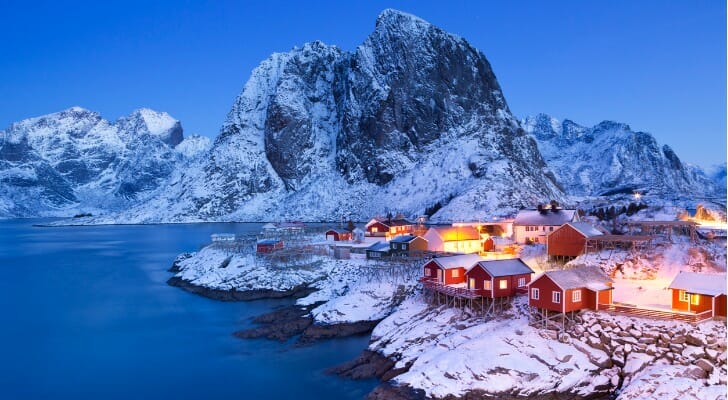
Learning how to retire in Norway opens the door to a peaceful life in one of the world’s most beautiful and socially progressive countries. While the cost of living is undeniably high, the exceptional quality of life, comprehensive healthcare system and breathtaking natural landscapes make it a worthwhile consideration for retirees with adequate financial resources. The retirement visa process requires careful planning and documentation, but for those who qualify, the benefits are substantial. Whether you’re drawn to the fjords, the northern lights or simply the calm, orderly Norwegian lifestyle, proper preparation is essential.
Tips on Retiring
- As you explore possible places to retire, consider talking to a financial advisor to help you sort through the costs of various options and which options you can afford. Finding a financial advisor doesn’t have to be hard. SmartAsset’s free tool matches you with vetted financial advisors who serve your area, and you can have a free introductory call with your advisor matches to decide which one you feel is right for you. If you’re ready to find an advisor who can help you achieve your financial goals, get started now.
- Part of sorting through your ability to afford retirement locations is knowing what your monthly Social Security check will be. A Social Security calculator will give you a pretty good estimate.
Photo credit: ©iStock.com/Eachat, ©iStock.com/CHUNYIP WONG, ©iStock.com/TKsara_winter
Article Sources
All articles are reviewed and updated by SmartAsset’s fact-checkers for accuracy. Visit our Editorial Policy for more details on our overall journalistic standards.
- Cost of Living in Norway. Prices in Norway. Updated May 2026. https://www.numbeo.com/cost-of-living/country_result.jsp?country=Norway.
- Andrade, Irene. “EXPLAINED: All the New Healthcare Changes in Norway You Need to Know.” The Local Norway, 23 Jan. 2026, https://www.thelocal.no/20260123/explained-all-the-healthcare-changes-in-norway-in-2026-you-need-to-know.
- Norway – Individual – Taxes on Personal Income. Jan. 20, 2026, https://taxsummaries.pwc.com/norway/individual/taxes-on-personal-income.
- “Currency Risk: Why It Matters to You.” FINRA.Org, Dec. 5, 2024, https://www.finra.org/investors/insights/currency-risk-why-it-matters-you.