 Edited by
  Edited by
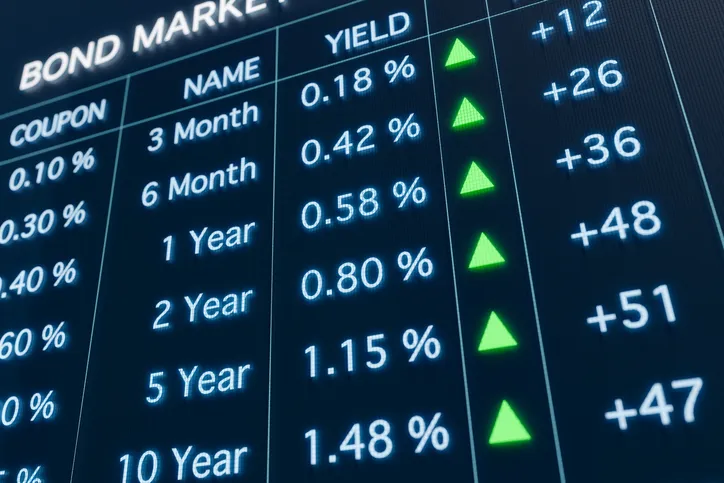
A U.S. bond sell-off occurs when selling pressure pushes bond prices lower and yields higher. These moves can reflect changing expectations for interest rates, inflation, and economic growth. They can also affect borrowing costs, existing bond holdings, and potential opportunities for investors purchasing newly issued bonds.
A financial advisor can help you evaluate how changing bond prices and yields may affect your portfolio and income plan.
Why U.S. Bond Prices Fall During a Sell-Off
Bond prices and yields generally move in opposite directions. A Treasury security’s coupon payment is fixed when it is issued. If market rates rise, newly issued bonds may offer higher yields, making an older bond with a lower coupon less attractive. Its price generally has to fall so that a buyer can earn a yield closer to the prevailing rate. When rates fall, the opposite can occur. Older bonds with higher coupons may become more valuable. The SEC describes this exposure as interest-rate risk.
A U.S. bond sell-off can have several possible causes. Investors may expect the Federal Reserve to keep short-term rates higher, worry that inflation will reduce the purchasing power of fixed payments, or anticipate stronger growth that delays future rate cuts. Concerns about heavier government borrowing can also affect yields because investors may require more compensation to absorb additional Treasury supply. No single market move proves which factor is responsible.
Longer-term bonds generally experience larger price changes when yields move because more of their value comes from payments that will not arrive for years. Duration measures this interest-rate sensitivity. Although duration and maturity are related, they are not identical; coupon size and other bond features can also affect duration.
How Rising Yields Can Reduce a Bond’s Value
To show how rising yields could affect a bond’s value, let’s break down the example of a $10,000, 10-year Treasury note with a 3% coupon. It pays $300 in annual interest in this simplified example regardless of what happens to prevailing market yields.
| Market Yield | Bond Price Calculation | Approximate Bond Price |
|---|---|---|
| 3% | $300 × [(1 − 1.03^-10) ÷ 0.03] + $10,000 ÷ 1.03^10 | $10,000 |
| 4% | $300 × [(1 − 1.04^-10) ÷ 0.04] + $10,000 ÷ 1.04^10 | $9,189 |
| 5% | $300 × [(1 − 1.05^-10) ÷ 0.05] + $10,000 ÷ 1.05^10 | $8,456 |
These figures are mathematical illustrations rather than observed market prices. Each estimated price is calculated by discounting the bond’s 10 remaining $300 annual interest payments, along with its $10,000 principal payment at maturity, using the stated market yield as the discount rate. As the required market yield rises, the present value of those fixed payments falls.
The estimates also assume annual payments, no accrued interest and no transaction costs. Actual Treasury notes pay interest semiannually, so their market prices would differ modestly from this simplified example.
When the market yield is 3%, the bond is worth approximately its $10,000 face value. At a 4% yield, a new $10,000 bond priced at face value would provide roughly $400 annually in this simplified example. The existing bond’s fixed $300 payment is less competitive, so its price falls to about $9,189. At a 5% yield, its estimated value drops further to approximately $8,456.
What Higher Treasury Yields Can Tell Investors
Rising Treasury yields can reflect expectations that short-term rates will remain elevated, inflation concerns, stronger growth or a higher premium for holding long-term debt. Longer-term Treasury yields can be viewed as reflecting expected future short-term rates plus a term premium, which helps explain why a yield increase does not have one definitive meaning.
Treasury yields also serve as reference rates across financial markets. Mortgage rates typically move with longer-term Treasury yields, though not one-for-one. Corporate bond yields are often evaluated as a comparable Treasury yield plus a credit spread. Therefore, a sustained rise in Treasury yields can contribute to higher borrowing costs for households and businesses.
Changes at different maturities also reshape the yield curve. A steepening curve means the gap between long- and short-term yields is widening, while a flattening curve means it is narrowing. These shifts can provide information about policy, inflation and growth expectations, but their meaning depends on which yields are moving and why.
How a Bond Sell-Off Affects Bond Funds and New Investors
A bond fund’s share price can fall when the value of its holdings declines. Funds with longer duration generally have greater sensitivity to rising yields, so a long-term fund may experience a larger decline than a short-term fund after the same rate increase. Bond funds can lose money even when they hold government securities.
| Bond Fund Type | Interest-Rate Sensitivity | Potential Price Impact When Yields Rise | Reinvestment Opportunity |
| Short-Term Bond Fund | Lower | Generally smaller | Maturing holdings can be reinvested at higher yields sooner |
| Intermediate-Term Bond Fund | Moderate | Generally moderate | Higher-yielding securities enter the portfolio gradually |
| Long-Term Bond Fund | Higher | Potentially larger | Portfolio income may adjust more slowly as holdings mature or are replaced |
Falling prices create a near-term loss in market value for existing shareholders, but higher yields may improve future income. As bonds mature or holdings change, a fund can replace lower-yielding securities with newer bonds paying more. This may help offset part of the decline over time, but the result depends on duration, credit quality, expenses and future rate changes.
New investors may also obtain more income for each dollar invested when yields are higher. But buying after a sell-off does not eliminate risk. Yields could rise further, and non-Treasury bonds carry credit risk in addition to interest-rate risk.
What to Consider When Bond Prices Are Falling
Selling a bond below its purchase price can turn an unrealized loss into a realized one. An individual bond held to maturity has a stated repayment date and amount, subject to the issuer’s ability to pay. However, receiving the bond’s face value at maturity does not necessarily prevent a loss if the investor originally purchased the bond above face value. A conventional bond fund continually changes its holdings and does not have one maturity date when shareholders automatically receive principal back.
Before changing an allocation, investors can review duration, maturity dates, and credit quality. They may also consider when the money will be needed, whether the bonds are intended to generate income or reduce investment portfolio volatility and whether higher current yields support their plan. Shorter maturities may limit rate sensitivity, while longer maturities involve different income and reinvestment trade-offs.
A financial advisor can help you evaluate how a bond sell-off affects your portfolio, income needs and broader asset allocation. Your response may depend less on a market headline than on whether your existing strategy still aligns with your time horizon, liquidity needs and tolerance for price fluctuations.
Bottom Line

A U.S. bond sell-off pushes prices down and yields up. That can reduce the current value of existing bonds and bond funds while increasing the income available on newly purchased securities. Investors may want to distinguish between interim price changes and holding an individual bond to maturity before deciding whether to buy, sell, or maintain an allocation.
Investment Planning Tips
- A financial advisor can help you decide when to hold existing bonds to maturity, adjust bond duration or take advantage of higher yields on new purchases. Finding a financial advisor doesn’t have to be hard. SmartAsset’s free tool matches you with vetted financial advisors who serve your area, and you can have a free introductory call with your advisor matches to decide which one you feel is right for you. If you’re ready to find an advisor who can help you achieve your financial goals, get started now.
- If you want to diversify your portfolio, here’s a roundup of 13 investments to consider.
Photo credit: ©iStock.com/Torsten Asmus, ©iStock.com/Wasan Tita