 Written by
 Edited by

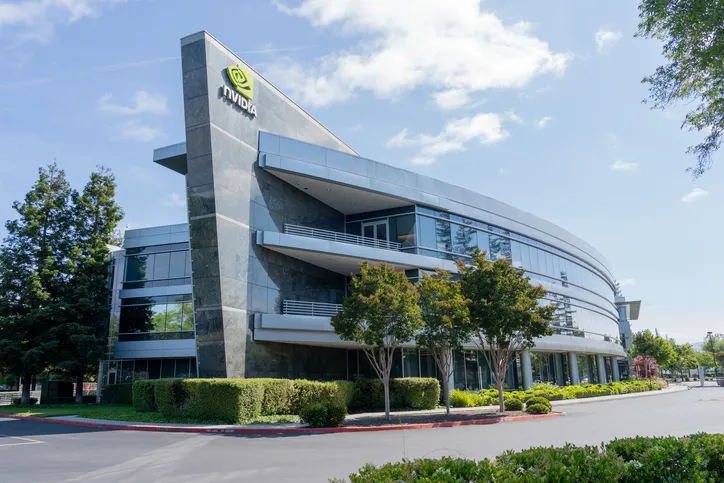
Nvidia was founded in 1993 as a maker of graphics chips for video games. Its graphics processing units (GPUs) are designed to perform many calculations simultaneously, a capability that has helped the company expand far beyond its gaming roots.
Today, Nvidia (NVDA) is one of the world’s largest technology companies, with a market capitalization of approximately $4 trillion as of November 2026. Its chips power artificial intelligence (AI), high-performance computing and the data centers that support these technologies. However, the company entered a new chapter in November 2026 when longtime CEO Jensen Huang resigned. Here’s how Nvidia makes money, how it grew into a technology giant and what to know about its recent leadership change.
There’s alpha in information. Sign up for the Market Minute newsletter to get summaries of stock market and economic news delivered right to your inbox.
Nvidia’s Products and Business
Nvidia’s core business model is the production of specialized, high-end computer processors. These chips are called “graphics processing units,” or GPUs.
A GPU is a specialized form of processor. It supports the central processing unit, or “CPU,” by taking on specific, high-demand tasks as they emerge. This allows your computer to operate normally while also running demanding software because, instead of having to put all other processes on hold, the CPU can hand off single, complicated calculations to the GPU. In essence, it’s a difference of breadth vs. depth.
A central processing chip is built to handle many different tasks at the same time, and its purpose is to run your computer overall. However, as a result, it has fewer resources for any given task. So, for example, the CPU can run the relatively simple calculations of your operating system, web browser and word processor all at once. But it will take a long time to process very complicated demands, which can slow down your computer overall. CPUs use both sequential and parallel processing to handle a wide range of tasks.

A graphics processing unit, on the other hand, is built to perform many similar calculations simultaneously. It can dedicate its resources to complicated tasks by breaking them down into smaller, repetitive operations and processing them at the same time. So, for example, a GPU can handle the enormously complicated math of rendering three-dimensional images very quickly (historically the most common use case for a GPU). However, GPUs are generally less suited than CPUs to managing a wide range of different tasks. This approach is known as “parallel processing.”
Graphics processing units (GPUs) got their name from their original purpose: rendering images and graphics, particularly for video games. Earlier generations of these chips were commonly known as graphics accelerators, but Nvidia helped popularize the GPU terminology with the introduction of its GeForce 256 in 1999. Throughout the 1990s and 2000s, increasingly sophisticated video games fueled demand for more powerful graphics hardware, helping Nvidia establish itself as a major supplier of chips for the gaming industry.
However, that is simply an accident of market demand, not a function of hardware limitations. Nvidia makes sophisticated computer processors designed to supplement core processing and solve specific, high-demand needs. In recent years, demand for specialized computing has grown significantly. These chips are used, among other industries, for blockchain mines, artificial intelligence processing, and data storage and distribution. As a result, demand for Nvidia’s chipsets has grown, and today industry-specific uses such as data centers and AI have surpassed consumer graphics as the core of the company’s business model.
Nvidia does make a range of additional products beyond the GPU, including laptops, cloud computing, and networking hardware. However the company is overwhelmingly known for their application specific chips, which make up the bulk of their brand and revenue.
Sign up for the Market Minute newsletter for summaries of the latest stock and economic news.
History of Nvidia
Nvidia was founded in 1993. The company was an early developer of GPU/ASIC technology, and was one of the first companies to turn these specialized chips into a consumer-oriented product.
During the first 20 years, the company specialized in graphics and gaming. Its core product, GPUs, also became known as “graphics cards” and are sold as add-ons for consumer computers. Customers can buy these products and add them to the mainboard of their computers, although to do this you need a desktop computer (rather than a laptop or tablet) and the computer must be capable of accepting modifications (rather than a sealed unit). Only particularly demanding gaming and graphics applications need this kind of hardware, so the consumer base has always been largely limited to hobby computer gamers and graphic artists.
This combination of hardware and market limitations make graphics cards a specialty product. During the 90s and 2000s, Nvidia became the industry standard within this niche. Arguably its only major competitors have historically been AMD and Intel, and even with Intel the company produces built-in graphics processors rather than supplemental hardware.
For most of its history, this remained Nvidia’s position. It has been the gold standard for a specialty product, and in doing so it significantly contributed to semiconductor technology and production techniques used industry-wide.
Nvidia IPO’ed in 1999 on the strength of core products such as the RIVA and GeForce processor lines. Starting in the 2000s, Nvidia became a supplier for video game consoles, including providing the graphics cards for Microsoft’s X-Box and Sony’s PlayStation. During this era, the company also began branching out into light industry uses, most notably providing graphics chips for automakers’ heads-up displays.

In the 2010s, Nvidia saw its business model begin to shift. During this era, entirely new software industries emerged that focused more on single, high-demand tasks. This included blockchain mines, high-volume data storage and distribution, video streaming, and artificial intelligence. This was a change from previous industry emphasis on efficient software that did more with less hardware, and it was an excellent fit for Nvidia’s specialty chipsets. This was particularly successful due to the company’s CUDA line of products, released in 2006 and built for research-oriented applications.
Since 2010, Nvidia’s business has moved steadily toward these industry-oriented practices. While the company still produces consumer graphics cards, and arguably remains the industry leader in that field, its main revenue now comes from corporate processor demand. In the second quarter of fiscal 2027, Nvidia reported $89 billion in data center revenue, accounting for more than 90% of its $96.2 billion in total quarterly revenue. 1
However that success has brought increasing scrutiny from the federal government. In recent years the FTC has increasingly begun looking at Nvidia’s market dominance from an antitrust perspective, which has in turn caused the company to back off from potential acquisitions.
Nvidia‘s Financials and Leadership
Nvidia is one of the most valuable publicly traded companies in the United States. As of Nov. 12, 2026, Nvidia had a stock price (NASDAQ: NVDA) of $166.19 per share and a market cap of approximately $3.95 trillion. 2 However, shares experienced significant volatility in November 2026 amid reports involving longtime CEO Jensen Huang and his subsequent resignation.
Nvidia has global operations. Its consumer-level business sells chips worldwide, except for jurisdictions in which the U.S. forbids it to do business (in some cases due to national security concerns). It operates offices across North America, South America, Asia and Europe.
Money is always in motion. Get the latest news affecting the markets, including the latest on Nvidia, right to your inbox with the Market Minute newsletter.
Nvidia Stock Split History
Nvidia has undergone six stock splits in its lifetime, including the most recent 10-for-1 split in June 2024:
| Date | Stock Split Ratio |
|---|---|
| June 10, 2024 | 10-for-1 |
| July 20, 2021 | 4-for-1 |
| September 11, 2007 | 3-for-2 |
| April 7, 2006 | 2-for-1 |
| September 12, 2001 | 2-for-1 |
| June 27, 2000 | 2-for-1 |
Nvidia Executive Team
Huang, a co-founder of the company, led Nvidia for more than three decades, beginning with the company’s founding in 1993. However, Huang resigned as president, CEO and a member of the board of directors on Nov. 11, 2026, amid reports of extramarital affairs, including one allegedly involving a woman suspected by the U.S. government of being a Chinese spy. 3
Nvidia turned to longtime chief financial officer Colette Kress to serve as interim CEO while its board searches for a permanent replacement. The company also named Harvey C. Jones as chairman of the board. Nvidia had previously announced was investigating the potential national security concerns raised by the reports but has no reason to believe company secrets or U.S. national security were compromised. 4
Beyond that, the company has a relatively lean leadership team. Four main officers round out Nvidia’s primary leadership, making it somewhat more executive-light than many companies of comparable size.
- Colette Kress, Interim CEO, EVP and Chief Financial Officer
- Chris A. Malachowsky, Founder and Nvidia Fellow
- Nick Parker, EVP, Worldwide Field Operations
- Debora Shoquist, EVP, Operations
- Tim Teter, EVP, General Counsel and Secretary
Bottom Line
Nvidia is a specialty processor and chipset company that has grown from a niche graphics card manufacturer into one of the world’s largest technology companies. Its role in developing the hardware used for artificial intelligence has driven much of its growth in recent years. However, the November 2026 resignation of longtime CEO Jensen Huang has introduced new uncertainty about the company’s leadership and future direction.
Tips On Researching the NASDAQ
- What is the NASDAQ? And why is it different from the New York Stock Exchange? Let’s dive into the higher risk, higher reward world of the NASDAQ.
- A financial advisor can help you build a comprehensive retirement plan. Finding a financial advisor doesn’t have to be hard. SmartAsset’s free tool matches you with up to three vetted financial advisors who serve your area, and you can have a free introductory call with your advisor matches to decide which one you feel is right for you. If you’re ready to find an advisor who can help you achieve your financial goals, get started now.
- Money is always in motion. Sign up for the free Market Minute newsletter to get news that may affect your portfolio, the stock market and the economy summarized and right to your inbox.
Photo credit: ©iStock.com/JHVEPhoto, ©iStock.com/Antonio Bordunovi, ©iStock.com/Adnan Ahmad Ali
Article Sources
All articles are reviewed and updated by SmartAsset’s fact-checkers for accuracy. Visit our Editorial Policy for more details on our overall journalistic standards.
- NVIDIA Announces Financial Results for Second Quarter Fiscal 2027. NVIDIA, 26 Aug. 2026, https://nvidianews.nvidia.com/news/nvidia-announces-financial-results-for-second-quarter-fiscal-2027/?utm_source=chatgpt.com.
- “NVIDIA Corporation (NVDA).” Yahoo! Finance, 12 Nov. 2026, https://finance.yahoo.com/quote/NVDA/history/?period1=1762732800&period2=1794580794.
- Chan, Kelvin. “Jensen Huang, a Global Salesman for Artificial Intelligence, Resigns from Nvidia after Affair.” Associated Press, 12 Nov. 2026, https://apnews.com/article/nvidia-megaspeed-china-singapore-huang-5403f152a601cf82ce939f1d24fffa0f.
- Mickle, Tripp, et al. “Nvidia Opens Investigation Into Jensen Huang’s Relationship With Suspected Chinese Spy.” The New York Times, 8 Nov. 2026, https://www.nytimes.com/2026/11/08/technology/nvidia-investigation-jensen-huang-china.html.