 Written by

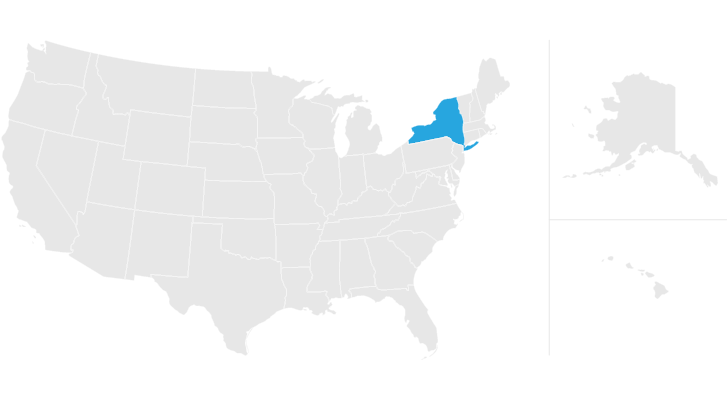
New York is one of 12 states, along with the District of Columbia, that tax the estates of decedents who were residents or who owned property located within its borders. Aside from this, there are many other factors that go into how the state handles inheritances, beginning with whether or not you have a valid will.
Do you need help with estate planning? Speak with a financial advisor today.
Does New York Have an Inheritance Tax or Estate Tax?
While New York doesn’t charge an inheritance tax, it does include an estate tax in its laws. The state has set a $7.35 million estate tax exemption for 2026 (up from $7.16 million in 2025), meaning if the decedent’s estate exceeds that amount, the estate is required to file a New York estate tax return. The state government requires that these be filed within nine months of the deceased’s death, though extensions are available. The highest tax rate you could possibly pay is 16%.
It’s generally necessary for the estate of a New York resident to file a New York estate tax return if the federal gross estate plus includible gifts exceeds the $7.35 million basic exclusion amount for a 2026 death. For a nonresident, a New York return may be required when the estate includes New York real or tangible personal property and the federal gross estate plus includible gifts exceeds the state exclusion amount.
New York also has an estate-tax “cliff.” If the taxable estate exceeds 105% of the applicable basic exclusion amount, the estate does not receive the benefit of the exclusion in calculating New York estate tax.
Other Necessary Tax Filings
The New York estate tax is in addition to the federal estate tax. For a U.S. citizen or resident who dies in 2026, a federal estate tax return is generally required when the gross estate plus adjusted taxable gifts and certain other amounts exceeds $15 million. The return is generally due nine months after death.
The $15 million figure is the 2026 federal basic exclusion amount. The amount of federal estate tax actually owed depends on the taxable estate, applicable deductions, credits and other factors. A six-month extension to file Form 706 is generally available when a timely extension request is made, although an extension to file does not automatically extend the time to pay the tax.
The federal and New York state governments also require a final individual state and a final individual federal income tax return to be filed by tax day of the year following the individual’s death. There may also be a federal estate or trust income tax return, Form 1041. Its due date generally depends on whether the estate uses a calendar or fiscal tax year rather than always falling on April 15.
An estate that is required to file its own tax returns generally needs an employer identification number (EIN). To apply for an EIN, visit the IRS website or apply by fax or mail.
How Estate Property Is Categorized in New York Inheritance Law
Property in New York is divided into two simple groups: personal property and real property. Included in real property are things like houses and land or, more broadly, real estate. On the other hand, personal property is just about everything else, such as cars, jewelry, furniture, cash, investments and family heirlooms.
New York is not a community property state. This means that a spouse won’t automatically receive most or all of the decedent’s property following his or her death, according to New York inheritance laws.
Dying With a Will in New York
For decedents who die with a will in New York, matters are pretty uncomplicated, with most wills being executed exactly as the decedent specified they should be. Just how this situation will be handled, though, is completely dependent upon the value of the estate and other factors. When formal probate is necessary, the will is submitted to the Surrogate’s Court so the court can determine its validity and authorize the executor to administer the estate.
The probate process in New York begins with a judge reviewing the will of the deceased, ensuring that it’s accurate and has all the information necessary for it to be considered valid. Be sure you signed your will in front of two witnesses, and that they sign as well. Following this, the executor listed on the will is formally named, and he or she begins distributing the property listed on the will to the intended beneficiaries.
This person is also responsible for settling any liabilities that the estate may still have pending, according to New York inheritance laws.
When filing for probate, the original will generally must be filed with the Surrogate’s Court, along with the death certificate, probate petition and other required documents. Filing requirements can vary depending on the circumstances of the estate.
However, if the decedent leaves $50,000 or less in qualifying personal property, a small estate proceeding, also called voluntary administration, may be available whether the decedent died with or without a will. The $50,000 limit generally excludes property set aside for qualifying family members under New York law. Voluntary administration does not give the administrator authority to administer real property.
Dying Without a Will in New York
An administration proceeding is the most common legal event that occurs in New York if you die without a valid will, but with real property to your name. If a person dies with $50,000 or less in qualifying personal property, a small estate or voluntary administration proceeding may instead be available.
Furthermore, if you die without a valid will, you’re titled as intestate by New York, and the state’s intestate succession laws govern the distribution of your property. This could mean a number of different relatives could end up in possession of your property. If the decedent’s only asset is real property, a formal administration proceeding may not always be necessary, depending on the circumstances and who survives the decedent.
As opposed to a probate court appointing a prespecified executor when there’s a will, proceedings without a will result in a judge choosing an administrator or personal representative. This administrator holds the same duty to handle the estate, only intestate law, not a will, dictates the way the estate is divvied up.
Spouses in New York Inheritance Law
New York utilizes a spousal right of election when deciding on inheritances for spouses. A surviving spouse’s elective share is generally the greater of $50,000 or one-third of the net estate, subject to New York’s rules governing which assets and testamentary substitutes are included. Should a spouse not receive this elective share, he or she has the right to file for it generally within six months after letters testamentary or letters of administration are issued, but no later than two years after the decedent’s death, subject to applicable extensions and exceptions.
If you and your spouse have no biological or adopted children together, and you have no children outside this marriage, then your spouse will receive all of your property. But if there are biological or adopted children involved, things change a bit. Under New York intestate succession law, your spouse will receive the first $50,000 plus half of the remaining estate. The decedent’s children or other descendants receive the balance by representation.
New York entitles surviving spouses of decedents who have disinherited them to a piece of their estate. The elective-share rules can reach certain non-probate transfers that New York treats as testamentary substitutes, so property outside probate is not necessarily excluded from the elective-share calculation.
Children in New York Inheritance Law
According to New York intestate succession law, biological children of the decedent are given full-fledged inheritance rights to their parent’s estate. Children born to unmarried parents can also inherit under New York law, although inheritance through a father can depend on whether paternity is established under the requirements of state law.
Adopted children, because they are considered the same as biological children in New York, possess full intestate inheritance rights. However, these same rights do not automatically apply to foster children and stepchildren if the deceased never adopted them.
According to New York inheritance laws, if you die before the birth of a child you conceived prior to your death, that child will still hold typical biological children’s intestate rights to your estate.
Specific intestate inheritance rights for the eligible children listed above vary depending on who survives the decedent as well. New York will give all property to your children if you’re unmarried or your spouse predeceases you. But if a spouse survives you, your children will only receive the balance of your estate after your spouse has received $50,000 plus half of the leftover estate balance.
Intestate Succession: Spouses & Children
| Inheritance Situation | Spouse’s Share | Children’s or Descendants’ Share |
|---|---|---|
| Spouse, but no children or other descendants | Entire estate | None |
| Spouse and children or other descendants | First $50,000 plus one-half of the remaining estate | Balance of the estate, distributed by representation |
| Children or other descendants, but no spouse | None | Entire estate, distributed by representation |
Grandchildren’s Inheritance Rights in New York
Grandchildren can inherit through intestate succession when their parent in the decedent’s line of descent does not survive the decedent and New York’s distribution-by-representation rules give them a share. If the decedent’s child who is the grandchild’s parent survives, that child generally takes the share instead of the grandchild. Of course, you can avoid any complications by naming your grandchildren as heirs to the specific property in your will, if you so desire.
Unmarried Individuals Without Children in New York Inheritance Law
The property in your estate will go to your parents if you die without a surviving spouse or surviving children. But if your parents predecease you, then your siblings and descendants of deceased siblings can inherit the estate by representation, according to New York inheritance laws.
If there is no surviving spouse, descendant, parent, sibling or descendant of a sibling, New York’s intestacy rules next look to grandparents and the descendants of grandparents. The law generally divides the estate between the decedent’s paternal and maternal sides, subject to statutory rules that determine which relatives on each side can inherit.
If none of those relatives survive, New York law can extend succession to qualifying great-grandchildren of the decedent’s grandparents. Only when there is no person entitled to inherit under the intestacy statute does the property pass to the state.
Intestate Succession: Extended Family
| Inheritance Situation | Who Inherits | Distribution |
|---|---|---|
| Parents, but no spouse or descendants | Parents | Entire estate to surviving parent or parents |
| No spouse, descendants or parents | Siblings and descendants of deceased siblings | Entire estate distributed by representation |
| No spouse, descendants, parents, siblings or descendants of siblings | Grandparents or qualifying descendants of grandparents | Generally divided between the paternal and maternal sides under New York intestacy rules |
| No closer qualifying relatives | Qualifying great-grandchildren of grandparents | Distributed under the statutory rules for each parental side |
| No person entitled to inherit under New York intestacy law | New York State | Estate escheats to the state |
If New York’s intestacy rules leave no qualifying relative entitled to inherit, the property can escheat to the state.
Non-Probate New York Inheritances
A non-probate asset in New York is a property that has its ownership transferred not via intestate succession laws or even a valid will, but instead through a beneficiary designation. The state includes in this group joint bank accounts, life insurance policies, retirement accounts and benefits, “in trust for” bank accounts, real property held by joint tenants and property held in a trust.
These assets can pass outside probate when the account, title, trust or beneficiary designation provides for a valid transfer at death. The applicable beneficiary or survivorship terms generally control the transfer. However, you can name your estate as a beneficiary, which would subject its inheritance to either your will or intestate succession.
Other Situations in New York Inheritance Law

Deathbed marriages are a growing trend in the U.S. They involve a caretaker or another opportunistic person marrying a decedent just before he or she dies solely for the purpose of gaining spousal rights to the inheritance.
New York courts can, in certain circumstances, address marriages allegedly obtained through fraud, undue influence or lack of capacity, including disputes that arise after a spouse has died. Whether a marriage can be challenged and what effect that has on inheritance rights depends on the specific facts and applicable New York law.
Resources for Estate Planning
- A financial advisor can help you build a comprehensive estate plan that accounts for your state’s inheritance laws. Finding a financial advisor doesn’t have to be hard. SmartAsset’s free tool matches you with vetted financial advisors who serve your area, and you can have free introductory calls with your advisor matches to decide which one you feel is right for you. If you’re ready to find an advisor who can help you achieve your financial goals, get started now.
- Managing your own estate, or handling the intricacies of inheriting money from the estate of a loved one who has passed away, includes many complex factors to consider. It can be such an overwhelming venture — with taxes to file, possible court proceedings to go through and more — that you might want some help, especially in understanding New York inheritance laws.
Photo credit: ©iStock.com/DNY59, SmartAsset.com, ©iStock.com/spyarm