
Overview of Washington Retirement Tax Friendliness
Washington State has no income tax. That means income from Social Security, pensions and retirement accounts is all tax-free in Washington. However, the state does tax long-term capital gains. Sales tax rates are quite high, as are home values and property taxes.
To find a financial advisor who serves your area, try our free online matching tool.
| Annual Social Security Income Dismiss | Annual Retirement Account Income Dismiss | Annual Wages Dismiss |
| Location Dismiss | Year of Birth Dismiss | Filing Status |
| Add Pension | |
| Annual Income from Private Pension Dismiss | Annual Income from Public Pension Dismiss |
| Your Tax Breakdown Federal State Local Total Taxes |
| is toward retirees. |
| Social Security income is taxed. |
| Withdrawals from retirement accounts are taxed. |
| Wages are taxed at normal rates, and your marginal state tax rate is %. |


Washington State Retirement Taxes
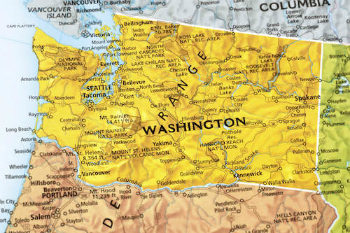
The Evergreen State is an increasingly popular retirement choice for seniors on the West Coast. Natural wonders like Mount Rainier, Olympic National Park and the San Juan Islands are a big draw for those seeking an active lifestyle. The state’s tax system is just as attractive for many seniors.
For starters, Washington State has no income tax. That means income from Social Security, pensions and retirement accounts all avoids taxes. It also means that those who plan to work part-time during retirement can likewise do so tax-free. Other taxes that will affect seniors in Washington include the state’s sales taxes, which are quite high, and property taxes, which are higher than the national median.
A financial advisor can help you plan for retirement and other financial goals. Finding a financial advisor doesn't have to be hard. SmartAsset’s free tool matches you with vetted financial advisors who serve your area, and you can have a free introductory call with your advisor matches to decide which one you feel is right for you. If you’re ready to find an advisor who can help you achieve your financial goals, get started now.
Is Washington State tax-friendly for retirees?
Washington State is one of nine states that do not have an income tax. That means any income from Social Security, a pension or a retirement account is tax-free at the state level.
That being said, some taxes in Washington State are quite high. The Evergreen State has the sixth-highest combined sales tax rate when adding the maximum local rate to the state rate. Washington also has its own estate tax with a fairly low exemption.
Is Social Security taxable in Washington State?
Social Security retirement benefits are not taxed at the state or local level in Washington State.
Are other forms of retirement income taxable in Washington State?
Since Washington State does not have an income tax, no forms of retirement income are taxable. While retirees in many other states have to pay state income taxes on 401(k), IRA and pension income, retirees in Washington do not. Federal taxes may still be due on those income sources, however.
How high are property taxes in Washington State?

Property tax rates in Washington State are slightly below the national median, but that doesn't mean homeowners pay less. Thanks to the state's high median home value ($602,200), the typical homeowner in the sate pays $4,729 per year in property taxes. The national median is just $3,211.
While housing in some parts of Washington is generally affordable, in some parts of the state it can be very expensive. This is especially true in the Seattle area. In King County, the median home value is nearly $900,000 and the median annual property tax bill is almost $7,300.
What is the Washington State property tax exemption for seniors?
Many senior citizens in Washington State are eligible for a program that reduces their property taxes. To qualify for the property tax exemption program, you must be either 61 years old or older, be unable to work because of a disability or be a veteran who is receiving disability compensation from the Department of Veterans Affairs (VA). You also must own and live in your home, and your household income must be lower than your county's income threshold. These thresholds have a median of $77,006 in the state and can be as high as $99,158 in King County.
If you meet these criteria, you will qualify for the exemption, which has two main benefits. First, your assessed value is frozen as of your application year so that any subsequent increases in value will not affect your property tax bill. Second, if your income meets certain requirements, some portion of your home value will be exempt up to a maximum of $70,000. The exact amount of the exemption depends on your income and your home value.
How high are sales taxes in Washington State?
Since Washington State does not have an income tax, it relies more heavily on the sales tax for revenue than many other states. The statewide sales tax is 6.5%. In addition to that state rate, cities and counties collect their own taxes that can be as high as 4.1%. Overall, expect to pay as much sales tax as 10.6% in Washington.
Sales tax exemptions in Washington should help seniors and retirees lower the overall burden of the state’s high sales taxes. Prescription drugs are exempt from sales taxes, as are groceries and newspapers.
What other Washington taxes should I be concerned about?
While the state does not levy an income tax, Washington taxes long-term capital gains. The first $1 million in gains are taxed at 7%, while gains above $1 million are subject to a 9.9% tax rate.
Washington also has its own estate tax with rates as high as 35% for decedents who die on or after July 1, 2205. The exclusion is $3 million. That amount is subtracted from the gross estate to calculate the taxable estate, so no taxes will be owed on an estate with a value below the exclusion.
Most Tax Friendly Places for Retirees
SmartAsset’s interactive map highlights the places in the country with tax policies that are most favorable to retirees. Zoom between states and the national map to see the most tax-friendly places in each area of the country.
Methodology Our study aims to find the areas with the most tax-friendly policies for retirees. To do that we looked at how the tax policies of each city would impact a retiree with a $50,000 income. Our hypothetical retiree is getting $15,000 from Social Security benefits, $10,000 from a private pension, $15,000 from retirement savings like a 401(k) or IRA and $10,000 in wages.
To calculate the expected income tax this person would pay in each location we applied deductions and exemptions. This included the standard deduction, personal exemption and deductions for each specific type of retirement income. We then calculated how much this person would pay in income tax at the federal, state, county and local levels.
We calculated the effective property tax rate by dividing median property tax paid by median home value for each city.
In order to determine sales tax burden we estimated that 35% of take-home (after-tax) pay is spent on taxable goods. We multiplied the average sales tax rate for a city by the household income less income tax. This product is then multiplied by 35% to estimate the sales tax paid.
For fuel taxes, we first distributed statewide vehicle miles traveled down to the city level using the number of vehicles in each county. We then calculated miles driven per capita in each city. Using the nationwide average fuel economy, we calculated the average gallons of gas used per capita in each city and multiplied that by the fuel tax.
For each city we determined whether or not Social Security income was taxable.
Finally, we created an overall index weighted to best capture the taxes that most affect retirees. We gave a 4x weighting to income tax, 3x weighting to property tax rate, a 2x weighting to sales tax and 1x weighting to fuel tax.
Sources: Internal Revenue Service, Social Security Administration, state websites, local government websites, US Census Bureau 2014 American Community Survey, Avalara, American Petroleum Institute, GasBuddy, UMTRI, Federal Highway Administration
