 Edited by
  Edited by
  Reviewed by

Independent contractors face unique challenges when it comes to retirement planning due to the lack of employer-sponsored plans. The good news is that there are several retirement plan options designed specifically for self-employed individuals, each with unique benefits and considerations. Popular choices include SEP IRAs, SIMPLE IRAs and solo 401(k)s, each offering distinct benefits and contribution limits. Retirement plans for independent contractors can provide significant tax advantages and flexibility, making them an attractive option for 1099 workers seeking to secure their financial future.
If you need help planning and saving for retirement, consider working with a fiduciary financial advisor.
Traditional IRA
A traditional IRA enables independent contractors to contribute pre-tax income, which can reduce taxable income for the year the contribution is made. The contribution limits for a traditional IRA in 2026 are $7,500 or $8,600 for people 50 and older. Contributions and earnings grow tax-deferred, meaning taxes are paid upon withdrawal during retirement.
How to Set Up a Traditional IRA
- Choose a provider: Select a financial institution such as a bank, brokerage, or robo-advisor that offers traditional IRAs.
- Open an account: Complete the account opening process, which typically involves providing personal information and selecting your investment options.
- Fund the account: Make contributions through direct deposit, check or electronic transfer.
- Choose investments for the account. These typically include stocks, bonds, mutual funds and other securities.
Roth IRA
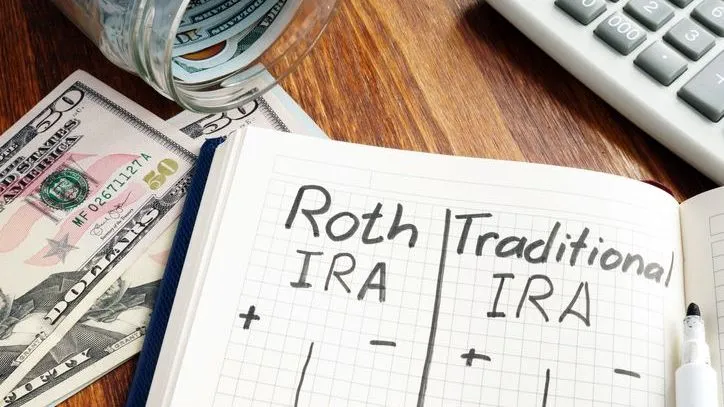
Roth IRAs are another popular option, funded with after-tax dollars. Although contributions are not tax-deductible, qualified withdrawals during retirement are tax-free. For 2026, the contribution limits for Roth IRAs are the same as traditional IRAs, set at $7,500 or $8,600 for those ages 50 and older. Roth IRAs are particularly advantageous for 1099 employees who anticipate being in a higher tax bracket during retirement. These accounts also aren’t subject to required minimum distributions (RMDs), which are mandatory withdrawals from pre-tax accounts that start at age 73 (75 for people born in 1960 or later).
How to Set Up a Roth IRA
- Eligibility check: Ensure you meet the income eligibility requirements. For 2026, the income limit for single filers is $168,000 (up from $165,000 in 2025) and $252,000 for married couples filing jointly (up from $246,000 in 2025).
- Select a provider: Choose a financial institution that offers Roth IRAs.
- Open an account: Fill out the necessary forms and choose your investment options.
SIMPLE IRA
A Savings Incentive Match Plan for Employees (SIMPLE) IRA is a retirement plan that allows both employers and employees to contribute to traditional or Roth IRAs set up for employees. For 1099 workers, acting as their own employer, the SIMPLE IRA presents a flexible and straightforward retirement savings option.
In 2026, the contribution limit for SIMPLE IRAs is $17,00, with a $4,000 catch-up contribution for workers who are 50 or older. Employers, or self-employed individuals, can match employee contributions up to 3% of their net earnings, or opt for a non-elective contribution of 2% of all employees’ compensation. As a result, an independent contractor can contribute both as an employee and employer.
How to Set Up a SIMPLE IRA
- Choose a provider: Find a financial institution that offers SIMPLE IRAs.
- Establish the plan: Complete the required forms, such as IRS Form 5304-SIMPLE or 5305-SIMPLE.
- Open your account: Open SIMPLE IRA accounts for yourself and any eligible employees.
- Choose investments for your own account. These investments generally consist of a mix of stocks, bonds, mutual funds and other investment options.
Choosing between account types can affect your future taxes and withdrawals. Try our retirement calculator below to see how your savings might grow under different assumptions.
SEP IRA

A Simplified Employee Pension (SEP) IRA is tailored for self-employed individuals and small business owners, including 1099 workers. SEP IRAs allow for higher contribution limits compared to traditional and Roth IRAs. For 2026, contributions can be the lesser of 25% of net earnings or $72,000. This higher limit enables significant retirement savings potential, with contributions being tax-deductible.
How to Set Up a SEP IRA
- Choose a provider: Find a financial institution that offers SEP IRAs.
- Establish the plan: Complete the required documents, such as IRS Form 5305-SEP.
- Open an account: Open SEP IRAs for yourself and any eligible employees.
- Make contributions: You can contribute up to 25% of your net earnings from self-employment, with a maximum limit of $72,000 for 2026.
- Choose investments for your own account. These investments usually encompass stocks, bonds, mutual funds and other securities.
Solo 401(k)
Solo 401(k) plans, also known as one-participant 401(k)s, are retirement savings plans designed specifically for self-employed individuals without employees (other than spouses). In 2026, the contribution limits for solo 401(k)s allow for substantial retirement savings. As an employee, independent contractors can contribute the lesser of 100% of their earned income or $24,500 in 2026 plus $8,000 catch-up contributions for those age 50 and above. Those between ages 60 and 63 can contribute an extra $3,250.
Additionally, they can contribute up to 25% of their net self-employment earnings as the employer (effectively 20% of adjusted net self-employment income for sole proprietors). Combined employee and employer contributions cannot exceed $72,000 in 2026, or $80,000 for those eligible for catch-up contributions.
How to Set Up a Solo 401(k)
- Select a provider: Choose a financial institution that offers Solo 401(k) plans.
- Adopt the plan: Complete the necessary plan documents provided by the institution.
- Open an account: Set up your Solo 401(k) account.
Taxable Brokerage Account
Taxable brokerage accounts offer a versatile way to save for retirement for independent contractors. Unlike traditional retirement accounts, these accounts don’t have contribution limits, giving contractors the freedom to invest as much as they wish. However, brokerage accounts don’t offer any of the tax incentives that tax-advantaged retirement accounts do.
A key advantage of taxable brokerage accounts is liquidity. Unlike traditional retirement accounts with early withdrawal penalties, funds in a taxable brokerage account can be accessed at any time without incurring additional charges. This feature is particularly useful for contractors who might need to tap into their savings for business expenses or unexpected costs.
How to Open a Taxable Brokerage Account
- Choose a brokerage firm: Research and select a reputable brokerage firm that meets your needs in terms of fees, investment options, and customer service.
- Fund your account: Transfer money from your bank account to your new brokerage account.
- Start investing: Once your account is funded, you can begin purchasing investments.
Bottom Line
Despite lacking employer-sponsored retirement plans, independent contractors have a variety of retirement plans available to them, each offering unique benefits tailored to their specific financial situations. From traditional and Roth IRAs to more robust options like SEP IRAs, SIMPLE IRAs and solo 401(k)s, self-employed individuals can find a retirement plan that suits their needs and allows for significant tax advantages and savings potential.
Retirement Planning Tips
- How much will you need in retirement savings to cover your projected expenses? SmartAsset’s retirement calculator can help you estimate the future value of your portfolio, whether it will be enough to cover your estimated expenses and how tweaking your savings rate can impact both.
- A financial advisor can help you plan and save for retirement? Finding a financial advisor doesn’t have to be hard. SmartAsset’s free tool matches you with vetted financial advisors who serve your area, and you can have a free introductory call with your advisor matches to decide which one you feel is right for you. If you’re ready to find an advisor who can help you achieve your financial goals, get started now.
Photo credit: ©iStock.com/, ©iStock.com/designer491, ©iStock.com/designer491