 Written by
  Edited by

If you have an old 401(k) at work, you might decide to roll it over to an individual retirement account (IRA). But does a 401(k) rollover count as IRA contribution? The good news is that rolling money from a 401(k) into an IRA does not count against your annual contribution limit. It can, however, affect your ability to make a contribution for the current year.
If you need help planning and saving for retirement, consider working with a financial advisor.
How Does a 401(k) Rollover Work?
Rolling over 401(k) plan money simply means that you move it into another retirement account. When you leave a job, you have three ways to manage your workplace retirement plan. You can either:
- Leave it where it is
- Cash it out
- Roll it over
Leaving your old 401(k) behind doesn’t mean you give up the money; you can still move it elsewhere later. But you may pay higher management fees to the plan since you’re now a former employee.
Cashing out a 401(k) can have tax consequences if you’re under age 59 ½. You must pay ordinary income tax on the withdrawal, along with a 10% early withdrawal penalty. Between taxes and penalties, you could walk away with significantly less money than you were expecting.
Moving your 401(k) into an eligible retirement account like an IRA can help you avoid tax penalties. You can invest the money in your IRA so it continues growing for your retirement. IRAs can also offer tax advantages.
401(k) to IRA Rollover
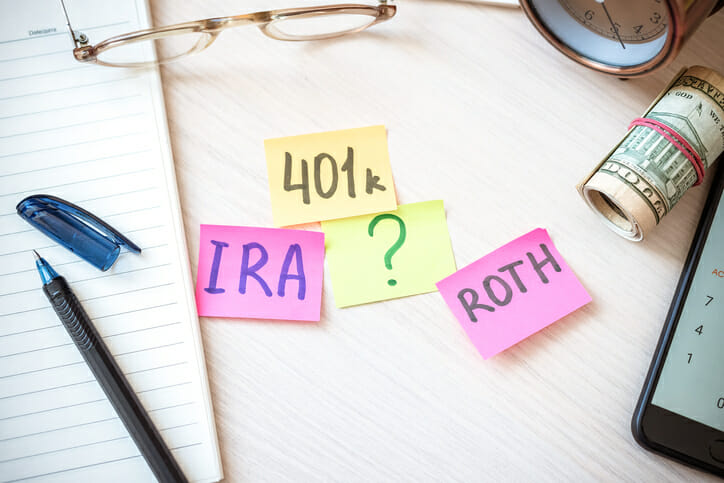
If you’re interested in rolling money from a 401(k) into an IRA, the process is fairly simple. In fact, you can ask your plan administrator to handle the rollover for you to ensure a smooth transfer of plan funds. You’ll need to decide what type of IRA to roll the money into if you don’t already have an IRA set up. There are two options to choose from:
- Traditional IRAs: A traditional IRA allows for tax-deductible contributions and withdrawals are taxed at your ordinary income tax rate. If you choose a traditional IRA rollover, you won’t owe any tax on your 401(k) savings until you withdraw money in retirement.
- Roth IRAs: Roth IRAs do not offer a deduction for contributions but you can get something better: tax-free withdrawals in retirement. The caveat is that you must pay taxes on any rolled-over amounts from a 401(k) at the time you move them to your IRA.
Thinking about your future tax bracket can help you choose between a traditional or Roth IRA. If you want to continue enjoying a tax deduction on contributions, then you might pick a traditional IRA. On the other hand, a Roth IRA might be more attractive if you expect to be in a higher tax bracket when you retire.
Does a 401(k) Rollover Count as an IRA Contribution?
The IRS imposes annual contribution limits on retirement plans, including IRAs. For 2026, the maximum contribution for traditional and Roth IRAs is $7,500 or $8,600 if you’re age 50 or older. Rolling over more than the annual limit from a 401(k) does not affect your ability to contribute to an IRA.
You may, however, hit a snag after rolling tax-deferred money from a 401(k) into a Roth IRA. If your modified adjusted gross income (MAGI) exceeds the annual limit set by the IRS for Roth IRA contributions, you won’t be eligible to make additional contributions to the account (beyond the conversion).
Here are the MAGI limits for Roth IRA contributions for 2026:
| Filing Status | Full Contribution | Partial Contribution | Roth Contribution No Longer Allowed |
|---|---|---|---|
| Single, head of household or married filing separately (did not live with your spouse during the year) | Less than $153,000 | Between $153,000 and $168,000 | $168,000 and over |
| Married filing jointly | Less than $242,000 | Between $242,000 and $252,000 | $252,000 and over |
| Married filing separately (lived with your spouse during the year) | N/A | Less than $10,000 | $10,000 and over |
The IRS does allow you to make reduced contributions at higher thresholds, though your ability to contribute to a Roth IRA phases out entirely above certain amounts. So if you’re thinking of rolling over 401(k) plan money, it’s important to consider how that could temporarily affect your ability to also make an annual contribution.
Should You Roll Over a 401(k) to an IRA?
Rolling over your 401(k) to an IRA could make sense if you want to pay less in management fees or you want access to a different range of investment options. You may also decide to roll over your old retirement accounts if you simply prefer to have all of your savings in one place.
When planning a 401(k) rollover, consider the direct transfer option. That can save time and potential tax headaches. If you decide to roll over the money yourself, there are a few rules to know:
- Rollovers must be completed within 60 days
- The plan administrator withholds 20% for taxes
Traditional and Roth accounts offer different tax benefits, but both play a role in retirement income. Run your numbers through SmartAsset’s retirement calculator to see how they might work together.
If you don’t complete the rollover within the 60-day window, the IRS may classify the whole amount as a distribution. You’ll owe taxes on the withdrawn amount and may also face a 10% early withdrawal penalty, depending on your age.
Your plan administrator will withhold the 20% for taxes before any money is sent to you. You can reclaim the withheld amount but there’s a catch. You still have to deposit the full amount you withdraw from your 401(k) into your IRA. So if your company withheld $5,000 or $10,000 for taxes, you’d have to make up the difference when you roll the funds over. Otherwise, you must pay taxes and possibly the early withdrawal penalty on that amount.
Rolling over 401(k) funds can be confusing if it’s your first time doing so. Talking to your financial advisor can help you decide how to approach it in order to minimize any potential tax liabilities.
Bottom Line

Rolling over your 401(k) to an IRA does not count toward your annual contribution limit, which is a good thing. But it can affect your ability to make a contribution if you have a Roth IRA. Weighing the advantages and potential downsides can help you decide if the timing is right to roll over your old retirement plan.
Retirement Planning Tips
- Consider talking to your financial advisor about where to open an IRA for a rollover if you don’t already have one. Finding a financial advisor doesn’t have to be hard. SmartAsset’s free tool matches you with vetted financial advisors who serve your area, and you can have a free introductory call with your advisor matches to decide which one you feel is right for you. If you’re ready to find an advisor who can help you achieve your financial goals, get started now.
- If you have a traditional IRA, you might also consider a Roth IRA conversion in order to reap tax benefits. By converting traditional IRA funds to a Roth IRA, you can withdraw that money in retirement tax-free. Similar to rolling over a 401(k) to a Roth IRA, you do have to pay taxes on the converted amount at the time of the conversion. You can ask your financial advisor about whether a Roth IRA conversion makes sense and how to complete one.
Photo credit: ©iStock.com/designer491, ©iStock.com/Lusyaya, ©iStock.com/Charday Penn