 Written by
  Edited by
  Edited by

Buyer personas are an important part of a financial advisor marketing plan. Among top-performing advisory firms, 87% rely on ideal client personas for marketing and client acquisition, according to Schwab’s 2026 RIA Benchmarking Study. Those firms saw 1.3x more growth in 2025, compared to their competitors.1 Personas can help you tailor your marketing to develop effective campaigns designed to convert those types of clients. Let’s look at how to create buyer personas based on the types of clients you’re hoping to attract.
Add new clients and AUM at your desired pace with SmartAsset’s Advisor Marketing Platform. Sign up for a free demo today.
Understanding Buyer Personas for Advisors
A buyer persona is a fictionalized representation of your ideal client. Buyer personas are most effective and useful when they’re fully fleshed out. The more detail you can add, the more accurate the resulting persona is likely to be. That’s invaluable for developing targeted marketing campaigns.
Buyer personas cover these categories:
- Demographics: Age, gender, geographic location, education, profession and income, marital and family status
- Psychology: Financial beliefs, values, goals and concerns, attitudes, interests and hobbies
- Challenges: Fear of outliving retirement savings, concerns about long-term care costs, debt repayment, legacy and estate planning
- Decision-making: Investment research style, preferred communication or engagement methods
Your persona may also include specifics about how your ideal clients find financial information and choose an advisor. For example, 75% of investors use artificial intelligence (AI) to research finances, but only 3% said they’d consider replacing their advisor with AI, according to a 2026 Betterment Advisor Solutions survey. 2
Triggering events are another consideration. A triggering event is a life change that might prompt someone to seek financial advice, such as a marriage or divorce, the birth of a child or a job change. Targeting prospects who fit your ideal client persona at a time when they’re experiencing such an event could offer an opportunity if you have the expertise and skill they need to navigate the change.

Client Acquisition Simplified: For RIAs
- Ideal for RIAs looking to scale.
- Validated referrals to help build your pipeline efficiently.
- Save time + optimize your close rate with high-touch, pre-built campaigns.

CFP®, CEO
Joe Anderson
Pure Financial Advisors
We have seen a remarkable return on investment and comparatively low client acquisition costs even as we’ve multiplied our spend over the years.
Pure Financial Advisors reports $1B in new AUM from SmartAsset investor referrals.
How to Develop Buyer Personas as a Financial Advisor

Now that you know what your buyer persona should cover, it’s time to build one. Note that you may need to create multiple buyer personas if you work with a variety of clients.
Here’s how to develop your first persona, step by step:
Create a Profile
Start by giving your ideal client a name. If you want to bring them to life even further, consider adding a stock photo headshot to their profile. Fill in the basics first, including their name, age, employment status, income and marital status. Then add in more details about their investments and risk tolerance.
Outline Client Needs/Concerns
What does your ideal client struggle with? Which financial concerns weigh most heavily? As you build your persona, list every possible scenario your ideal client may need help with.
Define Their Goals
Once you identify your ideal client’s biggest pain points, consider what they want to achieve financially. Be specific.
For instance, instead of saying your ideal client wants to invest for a secure retirement, you might say that they want to build a portfolio that generates a 10% return annually so they can retire at 65 with $1.5 million saved. That’s a tangible, trackable goal that you can build a workable plan around.
Assess Their Money Values and Beliefs
Behavioral finance attempts to explain the psychology behind people’s actions or beliefs surrounding money. As you develop buyer personas, ask yourself what your ideal client values most when it comes to their finances. Consider the types of experiences they may have had with money in childhood and how that may have shaped their financial attitudes as adults.
Identify the “Why”
Why does your ideal client need an advisor’s help? And what type of advisor experience are they looking for? Answering these questions can help you shape the language you use in your marketing so that your messaging speaks directly to their needs.
Consider Objections
No buyer persona is complete without an understanding of the objections your ideal client is likely to raise. For example, they might say they’re not comfortable discussing their finances with a stranger, or they already have a financial advisor. Identifying potential objections can help you prepare arguments to counter them should they arise.
Set Clear Expectations
An effective way to wrap up a buyer persona is to ask yourself what they expect from an advisor-client relationship. For instance, are they the type of client who prefers to be hands-on in the planning process, or will they leave the heavy lifting entirely to you? How do they prefer to communicate? What type of technology tools might they be interested in having access to as they manage their financial plans? All of these questions can help you shape your marketing so that you’re speaking not only to their needs and goals, but also to their expectations.
Build a Better RIA
Drive growth with automation, not headcount using the all-in-one advisor marketing platform.

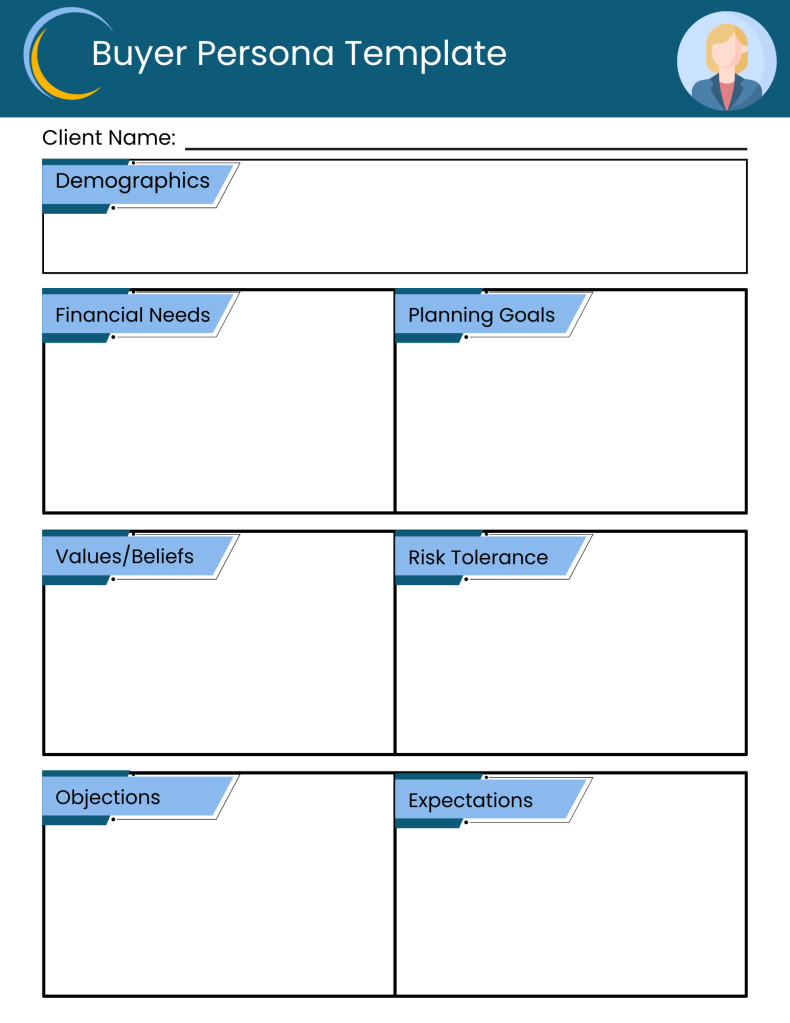
Financial Advisor Buyer Persona Template
Templates can simplify your business planning. You can use this financial advisor buyer persona template as inspiration for creating your own.
Frequently Asked Questions (FAQs)
What Are Buyer Personas?
Buyer or client personas are idealized representations of your ideal client. A buyer persona can offer insight into how your ideal client thinks and makes decisions, as well as what they need or expect from you as a financial advisor.
How Do Personas Help with Advisor Marketing?
Marketing without an ideal client in mind is like sailing without a compass; you need a set destination in mind to guide your decisions. Buyer personas allow advisors to develop marketing plans that reflect the exact person or persons they most want to serve. These plans help you send the right message to the right prospects in the right places.
Do Advisors Need an Ideal Client or Niche?
You don’t need to have an ideal client in mind or even a niche to be a financial advisor, but both of those things are helpful to have if you’re focused on growth. Client acquisition is less of a guessing game when you know who you want to target, how you can help them, and what kind of marketing strategies they’ll likely respond to most favorably.
Bottom Line

Buyer personas can play an important part in your advisor marketing plan. At the end of the day, the goal is to attract the kinds of clients you’re best suited and equipped to serve. If you have yet to develop a buyer persona for your firm, the strategies shared here can help you get started.
Tips for Growing Your Advisory Business
- How big is your firm’s digital footprint? Size matters for marketing, and without a solid strategy, it’s easy to get lost in the crowd. If you’re looking for a way to complement your current efforts, you might consider partnering with an advisor marketing platform. SmartAsset AMP (Advisor Marketing Platform) is a holistic marketing service financial advisors can use for client lead generation and automated marketing. Sign up for a free demo to explore how SmartAsset AMP can help you expand your practice’s marketing operation. Get started today.
- If you’re struggling to choose a niche, you may find it helpful to do a little self-assessment. For example, ask yourself what areas of financial planning you’re most qualified to help with. Consider which problems you’re uniquely positioned to solve and what competitors are doing to address those needs. Niching down can help you scale up if you’re attracting clients that other advisors are overlooking.
Photo credit: ©iStock.com/VioletaStoimenova, ©iStock.com/FG Trade Latin, ©iStock.com/ijeab
Article Sources
All articles are reviewed and updated by SmartAsset’s fact-checkers for accuracy. Visit our Editorial Policy for more details on our overall journalistic standards.
- Insights from the 2026 RIA Benchmarking Study. Charles Schwab, https://advisorservices.schwab.com/resource/ria-benchmarking-study-insights-2026.
- Karlson, Dana. Clients Are Already Using AI to Research Finances—Here’s How Advisors Can Help. Betterment Advisor Solutions, 10 Sept. 2026, https://www.betterment.com/advisors/resources/2026-advisory-survey-results.